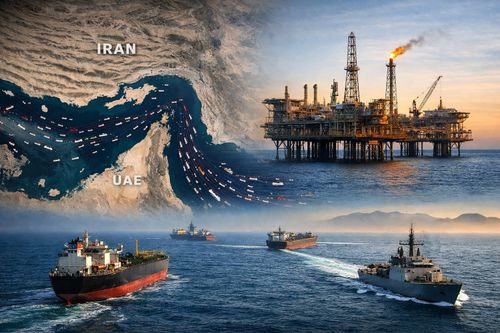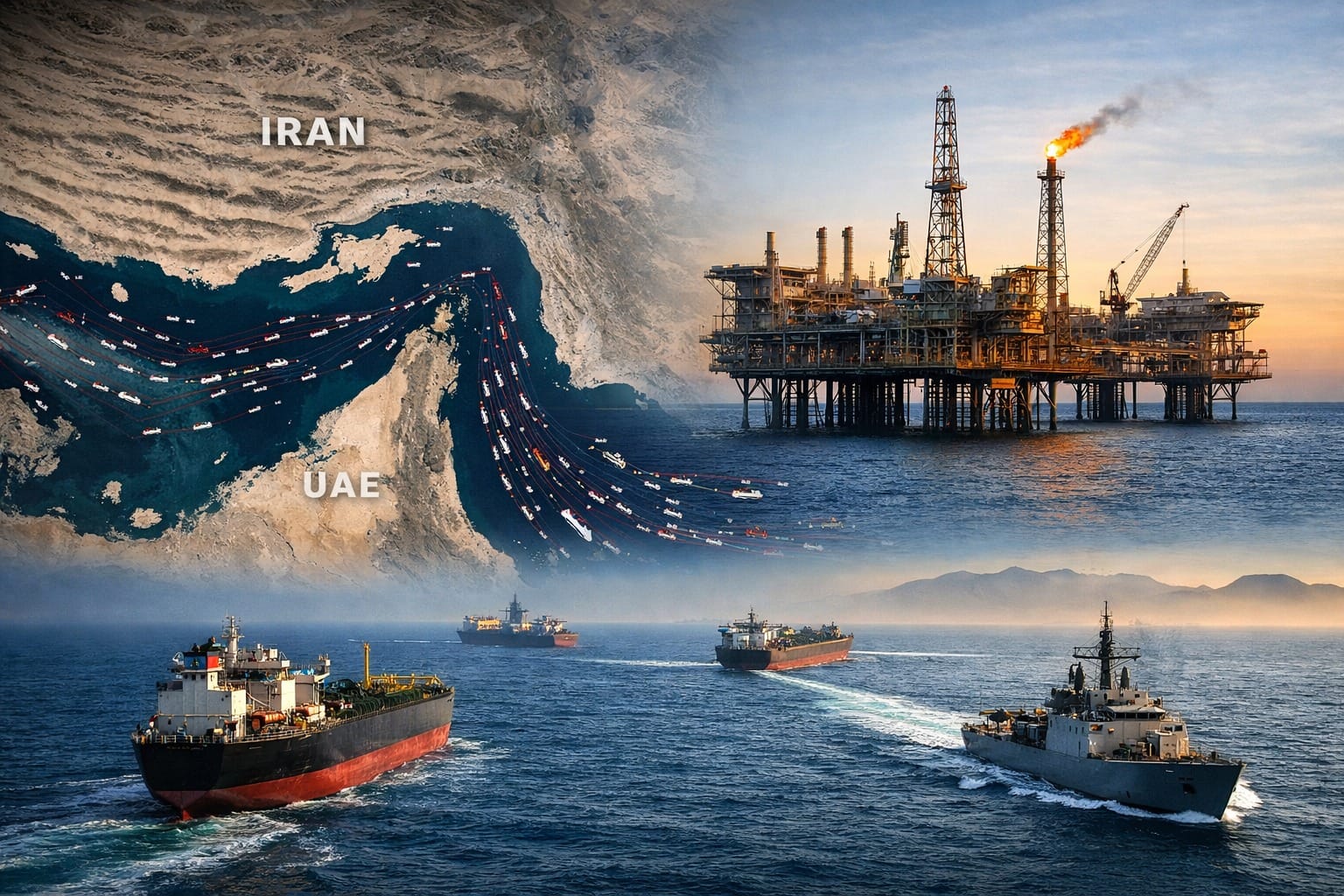




The instinct, when an energy system breaks, is to produce more of the fuel. Drill more. Ship more. Import more. Licence more acreage. Build more plants. Subsidise more supply. It is an instinct honed over a century - when the instinct worked.
In the first instalment of this series, we argued that this era has now closed. The collapse of the Strait of Hormuz is the release phase of the industrial energy system’s adaptive cycle — the moment at which a civilisational architecture built on cheap, abundant hydrocarbons begins to dismantle itself, because the operating conditions that sustained it have shifted. This instalment examines what happens when the old instinct meets the new reality.
Every response now being reached for — a revival of North Sea drilling in the UK, a deepening of LNG import capacity, new-build nuclear, even the spectre of European fracking — fails at least one of three tests. The timeline test: can it deliver within the 2026-2030 emergency window? The thermodynamic test: does its Energy Return on Investment trajectory go up, or down? The transmission test: does it break the mechanism by which gas prices transmit into household bills, or preserve it? Most of the responses now being proposed fail all three.
The production plateau nobody is pricing
The United States has been the world’s swing producer for the past decade. From 2015 to 2024, US shale delivered roughly 90 per cent of all the growth in global oil supply, lifting US production by more than 8 million barrels per day to over 20 mb/d. That era is ending. The US Energy Information Administration’s own Short-Term Energy Outlook now projects US crude production falling in 2026 for the first time in five years. Drilled-but-uncompleted wells have fallen to their lowest level since tracking began in 2013. Diamondback Energy, one of the largest independent shale producers, has publicly stated that production has peaked.
The global picture is starker still. The IEA’s recent study on oil and gas field decline rates finds that nearly 90 per cent of upstream investment since 2019 has gone to offsetting decline in existing fields, with only a small share directed to new supply growth. If tight oil and shale gas investment were to stop altogether, production would fall by over 35 per cent within twelve months. Under natural decline, advanced economies would lose 65 per cent of production over the next decade. The global industry is running to stand still.
This is the context in which the “OPEC spare capacity” argument dissolves. OPEC holds approximately 5.3 million barrels per day of theoretical spare capacity — the cushion to which policy papers and opinion columns routinely appeal. Every barrel of that capacity exports exclusively through the Strait the war has closed.
North Sea: geological sunset, industrial dawn
UK crude oil production fell nine per cent in 2024 alone. The Department for Energy Security and Net Zero’s December 2025 Energy Trends report documents a mature, high-cost basin in decline. The department’s own gas security of supply consultation acknowledges that the North Sea “will be unable to meet domestic demand within the next few years.” New licensing from first decision to first production typically runs five to ten years or longer. A barrel produced in 2031 arrives five years after the crisis the drilling is supposed to address.
The capital markets have already reached their own verdict. Shell has divested approximately $3.8 billion of North Sea assets between 2022 and 2025. BP has cut its North Sea capital allocation by around 40 per cent. Equinor is redirecting capital toward Norwegian offshore wind. These are internal rate of return decisions driven by hard commercial logic. New North Sea developments deliver IRRs of approximately 8 to 10 per cent. Offshore wind supported by Contracts for Difference delivers 12 to 18 per cent. Capital follows returns; it is leaving the basin precisely because the alternatives offer superior risk-adjusted performance.
There is a deeper point the North Sea debate keeps missing. The basin is transitioning. The same geographic feature that made Britain hydrocarbon-rich — the windiest sustained maritime corridor in the Northern Hemisphere, with average offshore wind speeds of 9 to 10 metres per second across large areas — makes it among the richest wind resources on Earth. The UK has deployed roughly 30 GW of offshore wind against a technically available resource estimated at over 1,000 GW. We are three per cent of the way through what is available.
The engineering expertise, subsea infrastructure competencies, regulatory architecture for offshore licensing and supply chain relationships built over four decades of North Sea oil development are directly applicable to wind at scale. The question facing UK policymakers is whether to spend the rest of the decade squeezing the last drops from a collapsing industry, or redirect the same institutional inheritance toward its highest-value future use.
Meanwhile, the oil lobby is actively using the Iran war to revive a drilling agenda that official UK government data shows would have negligible impact on household bills even if it produced anything. Most North Sea oil and gas sells into international markets at global prices, a point the UK government’s own Energy Security Strategy concedes. Domestic production trades at international market prices, severing any direct link to household bills. The drilling revival is the form fossil nostalgia takes in a collapsing system — rhetorically satisfying, analytically hollow.
Already have an account? Log In
LNG: the same rupture, twice
LNG diversification is the response European policymakers have leaned on hardest since 2022. The current crisis demonstrates its structural limit. LNG hedges against a particular supplier; fossil dependence itself stays exposed.
Consider the UK’s exposure. Approximately 45 per cent of UK LNG imports come from the United States; approximately 25 per cent from Qatar. US LNG supply rests on a quiet assumption that Asian spot prices remain sufficiently low that US exporters prefer European buyers — an assumption that has already failed repeatedly when Asian demand has spiked. Qatari LNG transits the Strait of Hormuz: the same chokepoint now constraining global oil supply.
The current crisis therefore exposes a compounding vulnerability in which the UK’s two largest LNG suppliers are simultaneously exposed to the same rupture, one through its export route and one through its production facility. Qatar’s force majeure declaration makes this concrete rather than theoretical: the Ras Laffan strikes of 18–19 March have removed 17 per cent of Qatar’s export capacity for three to five years, with six additional trains scheduled to come online by 2027 now facing indefinite delay.
The problem sits in the physics as much as the geography. Large-frame gas turbines required to restore LNG refrigeration compression are produced by only three manufacturers globally. Every one of them is carrying order backlogs of two to four years, driven by data centre demand. The timeline runs on supply-chain clock time. More than sixty billion cubic metres per year of European LNG regasification capacity has been built since 2022, each facility carrying twenty to thirty year utilisation expectations that will generate sustained commercial and political pressure against the demand reduction that makes them redundant. The LNG response is the most expensive way to stay exposed to exactly the risk that has just materialised.
Want deeper insights? Get access to detailed macrointelligence, scientific white papers, and investor briefings by subscribing to premium...
Nuclear: the wrong clock
Large nuclear is more credible than small modular reactors as a known technology. The recent European track record is sobering on cost and timeline. Hinkley Point C in the UK has seen its cost estimate rise from £18 billion to over £46 billion, with completion now delayed to 2031 at the earliest. Flamanville 3 in France was delivered more than a decade late and multiple times over budget. Olkiluoto 3 in Finland followed the same trajectory. These are consistent patterns across every major nuclear project in liberalised economies.
Small modular reactors are a different problem again. Every SMR design remains pre-commercial. NuScale’s first US project was cancelled on cost grounds in 2023. The UK government’s own assessment places first-of-a-kind SMR costs well above current onshore wind or solar. Licensing and construction timelines extend well beyond the 2026–2030 emergency window.
Large nuclear may have a bounded role as mid-2030s strategic insurance where projects are already under construction. The primary answer to the current crisis window lies elsewhere. New-build decisions taken today will deliver power in the late 2030s at the earliest — a decade after the emergency that is meant to justify them.
The thermodynamic floor
Beneath all of these responses sits an immovable thermodynamic floor. The Energy Return on Investment of fossil fuels — the ratio of energy extracted to energy spent extracting it — is falling on a trajectory documented across the peer-reviewed literature for years. Global fossil fuel EROI peaked at approximately 44:1 in the 1960s and has roughly halved since. French government researchers project that by 2030, a quarter of the energy the global oil industry produces will go to keeping itself producing; by 2050, around half.
This is the argument I traced through the Middle East and North Africa in my 2017 Springer Nature monograph Failing States, Collapsing Systems, which linked declining net energy returns to state fragility, political violence and the secular slowdown of global growth since the 1970s. Nine years on, the trajectory has held.
Each new barrel, each new cargo, each new field developed inside this trajectory costs more energy to produce than the one before. This is the reason 90 per cent of upstream capital now goes to offsetting decline rather than expanding supply. It is also the reason the fossil fuel response to Hormuz falls well short of the gap Hormuz has opened.
The seductive failure
The fossil fuel instinct is rational in the only way the last century taught us to be rational. Treasury knows how to tax hydrocarbons. Regulators know how to regulate them. Pension funds know how to hold them. Utilities know how to burn them. Lobbyists know how to defend them. A century of institutional memory is built around the assumption that energy policy is fuel policy. The assumption is embedded in the architecture of every energy ministry.
The adaptive cycle literature has a name for this. In the conservation phase, a system becomes so tightly optimised around its existing operating conditions that its own rigidity becomes its principal vulnerability. The reflexes that made it successful through the growth phase trap it when the environment shifts. Policymakers currently answering a release-phase shock with conservation-phase instruments are behaving predictably.
The next instalment will turn to what the reorganisation phase of the cycle looks like when it begins — and the specific doctrine, electrified sovereignty, that makes it operational. There is an exit route. The question is whether we spend the coming decade walking through it, or running ourselves to the ground on the same spot.
This series draws on a new working paper we have co-authored with the Club of Rome’s Earth4All initiative — Electrified Sovereignty as Solution to Iran War Energy Shock — with Sandrine Dixson-Declève (Earth4All), Vicente López-Ibor Mayor (formerly Lightsource BP) and Gerard Reid (Alexa Capital, World Economic Forum Future Energy Council). A compressed version of the argument appears in Byline Times.

If you appreciated this piece, sign up to get this newsletter delivered straight to your inbox for free. Or join premium to get access to deeper insights, white papers, scientific research and macrointelligence reports
Already have an account? Log In