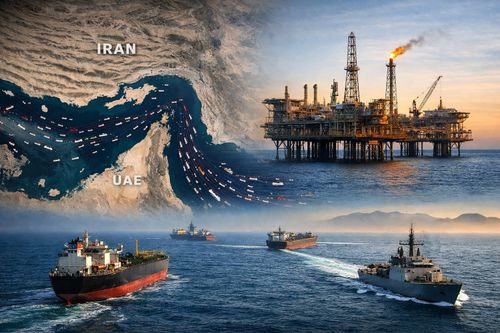



The Trump administration is a terminal regime. Its structural profile - high ideological intensity, significant overreach, and a hostile international environment - matches the fastest-dying regimes in the historical record of fascism, and no regime with comparable variables has survived a decade.
Over fifteen years ago, I predicted that the far-right would metastasise to the point that it takes over the heartlands of Western democracies. At the time, this was not taken seriously. It's now happening. Now, the very same systemic and cyclical forces that underpinned that forecast are pointing in a different, surprising direction: they reveal how the proto-neo-fascist order that is attempting to emerge is already on track to unravel over the next decade.
This doesn't mean fascism as a project is definitively finished. Cycles overlap, are complex, and systemic pressures can collide and converge in ways we simply cannot capture through our models and datasets. What this does mean, however, is that many of specific far-right political structures that have emerged over this last two decades have a terminal expiration date that can be mapped by integrating sociological and biophysical data.
On the basis of a systematic comparative analysis I conducted across eighteen historical fascist regimes, the probability that the MAGA project survives in its current form through the 2028 US presidential election is low, and through 2030 it becomes vanishingly small. The Trump project has also introduced a structural innovation not seen before in previous historical cases - a predatory mode of institutional capture that is eating the American state from the inside. That innovation compresses the timeline further.
The broader historical pattern could hardly be clearer. Every fascist regime that has ever existed is dead, with one hundred per cent mortality across the eighteen cases in my dataset and a median lifespan of only 8.5 years; more than half were gone within a decade. The only regimes that survived beyond two decades did so by ceasing to be fascist, demobilising the mass movement that brought them to power and abandoning the revolutionary ideology that defined them. That pathway is structurally foreclosed to the MAGA project, because permanent mobilisation is constitutive of MAGA’s identity.
Three other high-overreach fascist-adjacent regimes currently sit on the same terminal trajectory. Putin’s Russia, now in its fourth year since the invasion of Ukraine, tracks the upper bound of the historical range - an extension the model itself predicts, bought at the cost of exhausting the specific buffers (hydrocarbon revenues, Chinese support, accumulated repressive capacity) that the framework identifies as determining which high-overreach regimes die fast and which die slower. Those buffers are now visibly draining, and the closing window on the extension is 2027 to 2030.
Netanyahu’s Israel is held together by wartime conditions and the prime minister’s legal survival imperative, making it a coalition governing on borrowed stability. Modi’s India is navigating a succession-driven fork between calibration and high-overreach escalation that will be resolved within the decade. The pattern across these cases is unmistakable: high-overreach fascist-adjacent regimes, however differently they arrived at the configuration, converge on the same structural trajectory.
This essay distils the core findings from my new research report, The Fascist Lifecycle: A Comparative-Quantitative Analysis of Fascist Regime Survivability
and Its Implications for Contemporary Authoritarian Projects, which indexes the eighteen historical regimes across eight structural variables - ideology, institutional control, elite support, popular mobilisation, international environment, military overreach, leadership succession, and economic viability. The full technical analysis, including scoring rationale and statistical tests, is available in the research report, which you can download below.
Two dynamics that kill fascism
The dataset reveals two dynamics that overwhelmingly determine how long fascist regimes last.
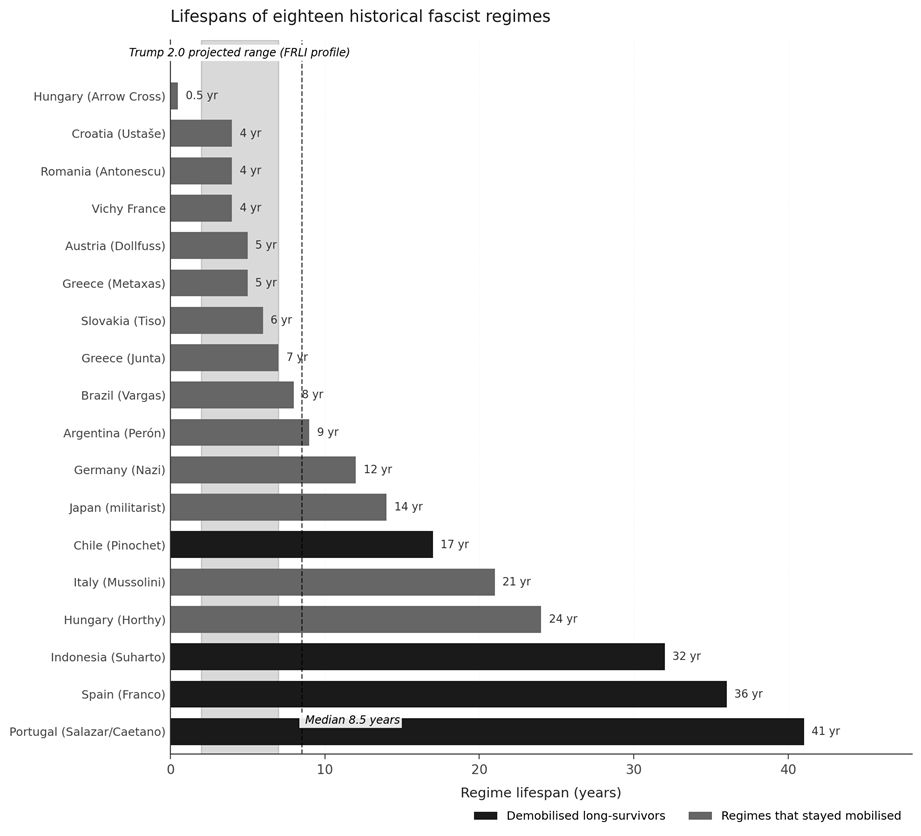
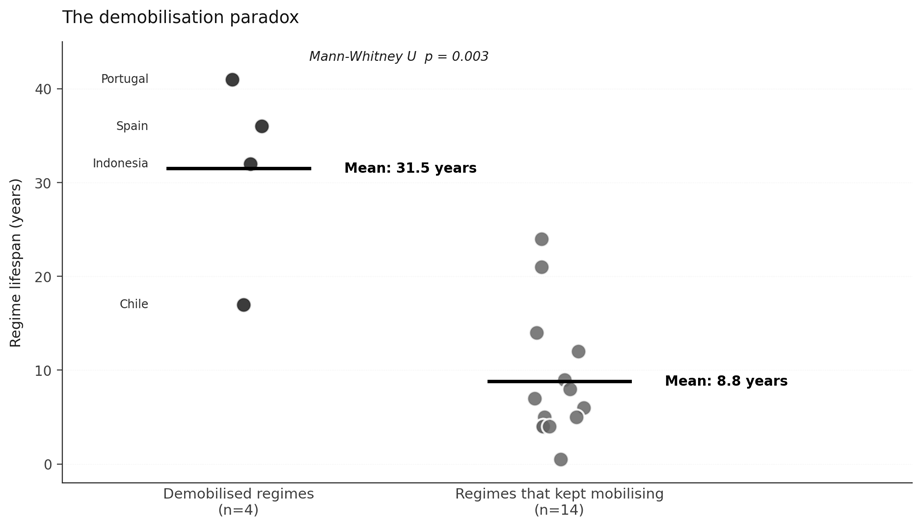
The first is what I call the demobilisation paradox. Some fascist regimes, after seizing power, eventually stood down the mass movement that had brought them there: they quieted the rallies, dropped the revolutionary rhetoric, and avoided foreign wars, governing instead through bureaucratic repression. Franco’s Spain lasted 36 years on this pattern, Salazar’s Portugal 41, Suharto’s Indonesia 32, and Pinochet’s Chile 17. The regimes that kept mobilising - that maintained the rallies, the grievance cycles, and the permanent civilisational emergency - lasted an average of just 8.8 years. The statistical divide between these two groups is sharp and confirmed by the data (Mann-Whitney U, p = 0.003).
The paradox runs deeper than a simple longevity bonus, because the long-survivors purchased their longevity by abandoning the defining features of fascism itself: mass mobilisation, revolutionary ideology, and expansionist ambition. They stopped being fascist. And even then, they eventually fell anyway - Franco’s system evaporated within three years of his death, Suharto collapsed in weeks when the Asian financial crisis hit, and Pinochet lost his own plebiscite. The lesson is stark: fascism cannot survive as fascism.
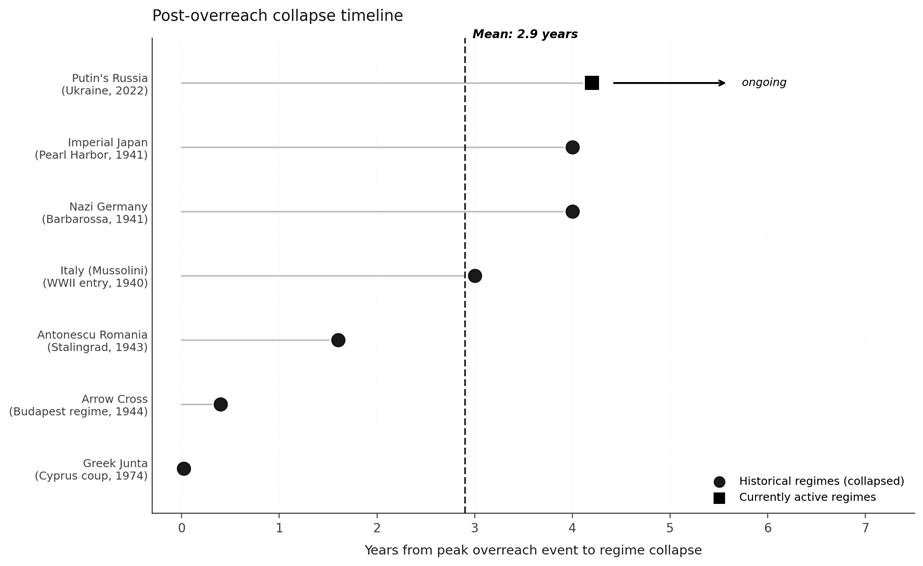
The second dynamic is overreach. Fascist ideology - with its doctrines of civilisational struggle, national rebirth through conflict, and the glorification of military expansion - functionally requires an escalating confrontation with external enemies. A fascist regime cannot remain fascist without picking bigger and bigger fights, and those fights kill it. Every regime in the dataset that scored high on overreach died within twenty-one years. Where we can identify the specific decision that committed the regime to its fatal confrontation, the average time to collapse is just 2.9 years: Italy entered the Second World War in 1940 and fell in 1943; Germany invaded Poland in 1939 and surrendered in 1945; the Greek Junta launched its Cyprus coup in July 1974 and collapsed within days. Once a fascist regime commits to the confrontation its ideology demands, the clock runs fast.
Want deeper insights? Get access to detailed macrointelligence, scientific white papers, and investor briefings by subscribing to premium...
The self-cannibalising regime
Based on this data, I put together a "Fascist Regime Lifecycle Index" (FRLI) to see if I could explore patterns. Scored against the FRLI, the Trump 2.0 administration presents a profile the dataset associates with the fastest-dying regimes: high ideological intensity (4/5), significant overreach (3/5), and a hostile international environment (1/5). The overreach score reflects the 2025 National Security Strategy, which explicitly frames American foreign policy around civilisational struggle; the tariff regime, which has sustained economic confrontation with effectively every major trading partner; and the Iran war, which marks the active escalation phase of the ideological project. The hostile environment score reflects the fact that the administration has alienated essentially every allied democracy that might otherwise provide strategic cover.
Every historical regime with a comparable structural profile has collapsed within a decade: the Arrow Cross in Hungary survived six months, Antonescu’s Romania four years, and the Greek Junta seven.
These figures, combined with the post-overreach 2.9-year mean, drive the quantified prediction: terminal decay of the MAGA project in its current form within the period running from approximately 2027 to 2030. That is the baseline projection from the historical dataset - and the Trump project has introduced a novel mechanism that compresses the timeline further still.
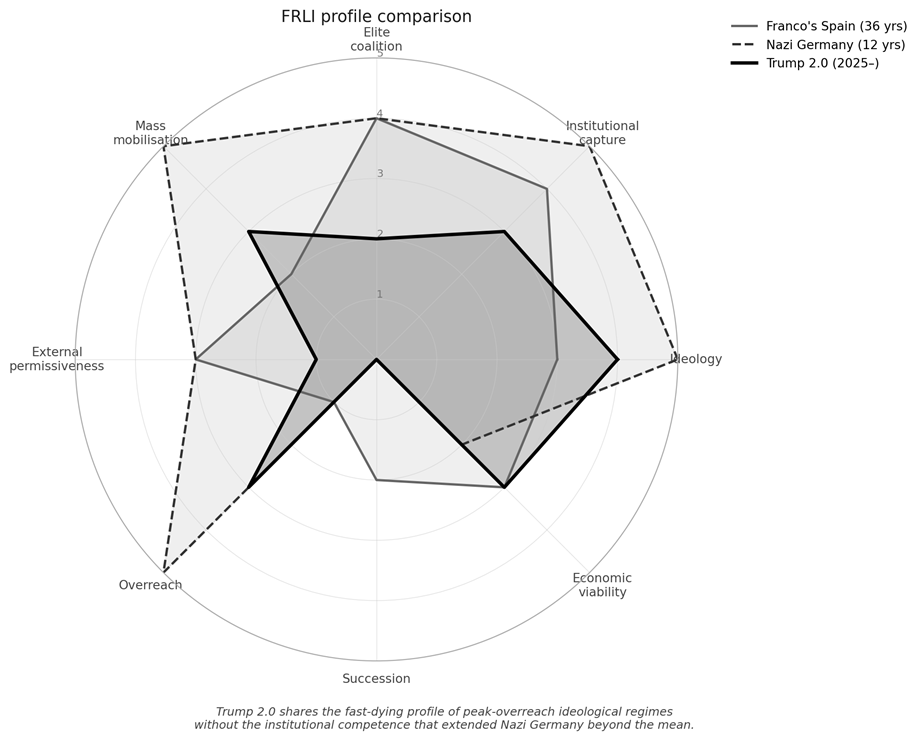
In my report, I draw a distinction I believe is critical. When fascist regimes have historically seized control of government institutions - the courts, the civil service, the military, the media - they redirected those institutions’ capacity toward the regime’s purposes. I call this consolidating capture. The state still functioned; it served the regime rather than the public, but its expertise and competence were preserved, because the regime needed functioning institutions to govern. Nazi Germany’s takeover of the state was total and terrifyingly efficient, Franco’s was selective and patient, and Orbán’s in Hungary was gradual - but in every case the courts still operated, the bureaucracy still administered, the economy was still managed. The trains still ran.
The Trump project is doing something qualitatively different, which I call predatory capture. The regime is cannibalising federal institutions - destroying their expertise, scattering their workforce, and eliminating their regulatory capacity - while the oligarchic interests driving the process extract private value from the wreckage. The regulators investigating your companies get fired, the agencies overseeing your contracts get gutted, the consumer protection bureau that would police your payment platform gets shut down, and the inspectors general auditing your government work get dismissed. Institutional capacity built over decades is liquidated, and the resulting regulatory vacuum flows directly to the financial benefit of the people who dismantled it.
The scale is staggering. By March 2026, approximately 9 per cent of the civilian federal workforce - over 200,000 positions - had been eliminated through the DOGE operation, with entire agencies functionally destroyed, among them USAID and the Consumer Financial Protection Bureau. More than one million federal workers lost their union bargaining rights. Schedule Policy/Career took effect in March 2026, stripping civil service protections from an estimated 50,000 positions and converting career professionals into at-will employees who can be dismissed for political disloyalty. The Supreme Court cleared the path with an 8-1 ruling enabling mass workforce reductions, and has signalled its readiness to overturn ninety years of law protecting the independence of regulatory agencies from presidential control. Alongside this, the administration has systematically withheld funds that Congress legally appropriated - seizing the power of the purse in violation of the Impoundment Control Act - on a scale unseen since Nixon.
The oligarchic dimension is what makes this historically unprecedented. The world’s richest man, Elon Musk, was granted operational control over the dismantlement process while his companies - Tesla, SpaceX, Neuralink, X, The Boring Company - were under active investigation by at least eleven federal agencies, and Senate investigators documented that DOGE directed or influenced funding and staffing decisions at many of the agencies investigating Musk’s companies. The National Labour Relations Board, which had active cases against SpaceX, Tesla, and X, was shut down; FDA employees overseeing Neuralink were fired; the CFPB, which would regulate Musk’s planned payments platform, was shuttered after he posted “CFPB RIP” with a gravestone emoji; and the Justice Department dropped its discrimination case against SpaceX. Meanwhile, SpaceX continued accumulating government contracts worth tens of billions of dollars. As Senator Warren put it: a bank robber trying to fire the cops.
The consequences for the capacity of the federal government are already severe, and in some areas irreversible. The administration was forced to rehire workers it had fired after discovering it had eliminated critical capabilities - including personnel combating H5N1 avian influenza and staff managing nuclear security - while NASA whistleblowers warned of potential astronaut deaths from the staffing cuts, the IRS experienced its worst filing season since the pandemic, and Veterans’ healthcare faces the loss of up to 35,000 positions including doctors and nurses. Institutional knowledge accumulated over decades - relationships, regulatory expertise, scientific competence - cannot be reconstituted by hiring inexperienced replacements screened for political loyalty.
The distinction between consolidating and predatory capture carries decisive implications for the timeline of regime failure. A regime that takes over institutions and keeps them functional becomes more rigid over time - brittle, but still capable of operating in the short term, and able to endure for years before it meets the shock it cannot absorb.
A regime that takes over institutions by destroying them has already lost the competence that might otherwise slow a future crisis, so every month it operates in this predatory mode, it compounds its vulnerability: it is generating the crises of overreach while simultaneously eliminating the institutional capacity to manage them. Think of it as a political autoimmune disorder, the regime’s own apparatus destroying the body it inhabits.
This is why the 2.9-year mean historical interval from peak overreach to regime failure sets the baseline for the Trump project rather than its worst case. Every high-overreach regime in the dataset that sat at the slow end of the distribution - Nazi Germany, Imperial Japan - extended its lifespan nominally because its state apparatus, however malign, remained competent enough to sustain the confrontation for several additional years; in both cases, those extra years were bought by preserving the institutions the regime had captured.
The Trump administration, in contrast, is systematically destroying that kind of competence in its own state apparatus, eating the very institutions that might have bought it time. The data therefore suggests that the regime ends at a timeline closer to the fast end of the historical distribution than the slow end, and with compounding damage that outlasts it.
Why fascism dies: the pattern
To understand why these patterns hold with such consistency, let's remind ourselves of the the underlying framework of change. All complex living systems - forests, economies, civilisations - move through a predictable cycle. The ecologist C.S. Holling identified four phases, and I formalised this as a civilisational-scale framework in my peer-reviewed paper ‘Planetary phase shift’, published in the journal Foresight in 2024, building on my books A User’s Guide to the Crisis of Civilization and Failing States, Collapsing Systems.
The cycle begins with growth, a phase in which the system expands and diversifies - think of a young forest spreading across open ground, or an economy in a boom. As the system matures, it enters conservation: the forest canopy closes, the economy consolidates, and everything becomes tightly optimised for current conditions. But this efficiency comes at a cost: the system loses flexibility. Dead wood accumulates on the forest floor, debts pile up in the economy, and the system - adapted ever more perfectly to the world as it is - becomes progressively less able to cope if conditions change. Then comes release: the accumulated rigidity meets a shock the system cannot absorb, whether a fire sweeping through or a financial crisis hitting, and the structure that took decades to build comes apart rapidly. Finally, reorganisation: the cleared ground becomes raw material for something new.
Fascist regimes drive themselves deep into the conservation phase with deliberate intensity. They are rigidity traps - systems that have maximised internal control at the expense of any capacity to adapt. The single-party state eliminates political diversity; mass mobilisation locks all societal energy into a single ideological channel; the cult of the leader concentrates every major decision into a single irreplaceable person; and the suppression of dissent eliminates the feedback mechanisms that would otherwise let the regime detect and respond to changing conditions. The result is a system that appears overwhelmingly powerful but has lost the capacity to absorb shocks. And the shock is self-generated: fascism’s ideology of civilisational struggle requires escalating confrontation with external enemies, which means the regime cannot remain fascist without picking bigger fights - and it cannot survive the consequences.
The long survivors pulled back from that deepest rigidity. Franco, Salazar, Suharto, and Pinochet each shifted from the fascist configuration to a shallower form of authoritarian control, which bought them time. But even they eventually met the shock they could not absorb.
Already have an account? Log In
The survival model MAGA cannot adopt
Some durable authoritarian regimes have already outlasted the fascist median by a wide margin: Putin’s Russia has governed for twenty-six years, Erdoğan’s Turkey for twenty-three, Orbán’s Hungary for sixteen, and Chávez and Maduro’s Venezuela for twenty-seven. Political scientists call these competitive authoritarian systems - regimes that maintain a democratic façade (elections, courts, some opposition media) while systematically tilting the playing field in favour of the ruling party.
These regimes survive because they keep the temperature low. Putin wants political apathy, not revolutionary fervour: his party, United Russia, is a bureaucratic machine for manufacturing passive consent, the structural opposite of a fascist mass movement. Orbán mobilised voters at election time but governed between elections through institutional patience and strategic restraint, while Erdoğan operates within an electoral framework that still permits genuine competition.
Evidence that arrived during the writing of this analysis deepens the picture. On 12 April 2026, Orbán’s Fidesz lost the Hungarian parliamentary election to Péter Magyar’s pro-European Tisza party, ending sixteen years of continuous rule. Orbán was the most disciplined competitive authoritarian in the entire dataset, and his fall was electoral, driven by accumulated economic grievance, corruption revelations, and the regime’s deepening entanglement with Russia.
Leaked recordings of his foreign minister sharing confidential EU documents with Moscow shattered the carefully maintained image of sovereign pragmatism. The Trump administration intervened directly - Vice President Vance visited Budapest on 7 April and Trump personally endorsed Orbán - and the intervention proved electorally toxic, with the MAGA brand turning American endorsement into a liability among Hungarian swing voters. The transatlantic strategy codified in the 2025 National Security Strategy was tested at its strongest European node and failed.
Two features of Orbán’s defeat are notable. First, the very strategy that had extended his regime - keeping the population politically passive between elections - also meant he had no mobilised base to defend him when a genuine electoral challenge finally crystallised. This is exactly the dynamic that destroyed Suharto: when the economic compact broke, there was nothing to fall back on. Second, the most disciplined competitive authoritarian model in Europe could not, in the end, survive the elections it had preserved as its legitimising shell.
MAGA cannot become Orbánism. Orbánism requires patience, institutional gradualism, and strategic restraint - qualities MAGA’s ideological engine structurally rejects. The rallies, the grievance cycle, the civilisational-threat framing of the 2025 NSS, and the simultaneous confrontation with domestic institutions and international allies are defining features of the project, inseparable from its coherence; the MAGA coalition would dissolve if deprived of them. And as Hungary has just demonstrated, even Orbánism itself could not ultimately survive. The competitive authoritarian pathway offers no permanent refuge, and it is structurally foreclosed to a movement built on permanent mobilisation and civilisational struggle.
The wider pattern
The Trump project stands as the most consequential case of fascist-adjacent governance in the world today, but three other regimes are currently sitting on terminal structural configurations.
Russia is the clearest parallel, and requires some additional explanation. Putin’s full-scale invasion of Ukraine in February 2022 was a textbook peak-overreach event, and the 2.9-year mean interval from such an event to regime collapse would have implied breakdown in early 2025. The regime is now in its fourth year post-invasion - a trajectory that sits squarely within the model’s expected range, rather than defying it. The 2.9-year figure is a mean: the historical dataset ranges from days (the Greek Junta collapsed within three days of its Cyprus adventure) to six years (Nazi Germany from its 1939 invasion to 1945 surrender, and Imperial Japan from Pearl Harbor in 1941 to surrender in 1945). The FRLI framework makes explicit what determines where in that range a regime sits.
Three variables determine the speed of a high-overreach regime’s collapse. The first is the depth of institutional capture - whether the regime controls a state apparatus competent enough to sustain the confrontation under pressure. The second is the economic base - whether the regime has the resources to absorb the costs of the confrontation as they accumulate. The third is the depth of repressive capacity - whether the regime can suppress internal dissent as military, economic, and reputational damage mount. Nazi Germany and Imperial Japan both scored high on all three: they had captured state apparatuses that functioned efficiently, industrialised economies that could sustain total mobilisation, and repressive infrastructures capable of maintaining internal order even as the war went catastrophically against them. Those three buffers bought them four to six additional years beyond the mean. The Greek Junta, by contrast, scored low on all three, and collapsed in days.
Putin’s Russia scores high on all three. Institutional capture is extensive and consolidating - the state still functions, the FSB still operates, and the bureaucracy still administers the war economy. The economic base is genuinely significant: Russia’s hydrocarbon revenues, while diminished by sanctions and the loss of European markets, have been substantially redirected through discounted sales to China and India. Repressive capacity is deep, built over two decades of methodical opposition suppression, consolidation of the security services, and neutralisation of independent media. These are the buffers that have extended the regime beyond the 2.9-year mean, in precisely the way the historical pattern predicts for high-overreach regimes with this kind of structural foundation. The question is how long those buffers last - and they are demonstrably draining.
Russia's hydrocarbon revenue base is structurally eroding. Russian oil production peaked in 2019. The European market is effectively gone and cannot be rebuilt. Chinese and Indian buyers extract significant discounts, reducing per-barrel revenue, and global demand for fossil fuels is projected by the International Energy Agency to peak before 2030 - after which the revenue base shrinks further even without additional sanctions. The war itself is consuming roughly a third of the Russian federal budget, and the National Wealth Fund, the regime’s rainy-day reserve, has been substantially drawn down on war financing. The Chinese support relationship, meanwhile, is conditional and transactional: Beijing has consistently provided just enough economic cover to prevent Russian collapse while extracting significant concessions on Central Asia, Arctic resources, and strategic technology transfer. It functions as a managed leash rather than a permanent backstop.
The succession question is the other accelerant. Putin is 73 and turns 76 in 2028, and Russian regime transitions are historically chaotic - the Soviet collapse, Yeltsin’s turbulent presidency, and even the 1999–2000 Putin handover from Yeltsin all involved significant elite manoeuvring and uncertainty. A contested succession in a regime already under extreme wartime pressure, with declining revenues and accumulated elite grievance, would be the classical trigger for the regime breakdown the 2.9-year mean predicts. On this reading, the clock is running on the succession crisis the invasion is building toward, as much as on the invasion itself.
This suggests that the closing window on the Putin extension is 2027 to 2030, when economic buffer exhaustion, succession pressure, and the cumulative costs of the war converge. Whatever emerges from the post-Putin transition will not be the Putin regime: the likely trajectories run from chaotic oligarchic breakdown (a Yeltsin-type scenario), to managed competitive-authoritarian retreat under a Putin-lite technocratic successor, to - less plausibly - a harder and more ideologically strident successor attempting to rescue the regime by escalating the confrontation further. Each trajectory breaks the current configuration.
Israel under Netanyahu’s current coalition is the other accelerating high-overreach case. The coalition that took power in late 2022 brought into cabinet parties with openly supremacist ideologies, and the 2023 judicial reform project attempted to eliminate Supreme Court constraints on executive power. The Gaza campaign, the Lebanon operations, and the confrontation with Iran together constitute a sustained high-overreach event spanning multiple theatres simultaneously, and the international consequences - ICJ proceedings, European policy shifts, Arab state recalibration, and Global South alignment - constitute precisely the hostile international environment the FRLI identifies as consistently lethal. The coalition is held together by wartime conditions and the prime minister’s legal survival imperative, and coalition collapse, regime transition, and political reconfiguration are probable within the current electoral cycle.
India under Modi presents the most analytically challenging open question. The Hindutva project - Hindu-nationalist civilisational ideology, mass mobilisation through the RSS organisational network, and systematic erosion of democratic constraints - meets more of the historical fascist criteria than any other current government outside the Trump case. What has held India short of full fascist configuration is scale: federalism, state-level pluralism, and a press diversity that has survived significant pressure. The 2024 election results were telling - the BJP lost its outright parliamentary majority and now governs through coalition. Modi himself will exit the scene within this decade, and the BJP succession dynamics will determine whether Hindutva calibrates toward an Orbán-style managed authoritarianism or escalates toward the high-overreach pathway the historical data shows is terminal.
The pattern across these cases is unmistakable: high-overreach fascist-adjacent regimes, however differently they arrived at the configuration, converge on the same structural trajectory. The clock is running on all of them.
Four scenarios, one conclusion
The historical patterns, combined with the unprecedented predatory character of the Trump project’s institutional capture, imply four scenarios for the United States. Each scenario shares a common feature - none is consistent with durable fascist survival, and all tend toward some form of breakdown. The open question is what kind of wreckage is left behind.
Scenario A - Degradation and correction (most probable, timeline uncertain). The project’s combination of high overreach, predatory institutional capture, and hostile international environment produces compounding dysfunction that triggers correction. The correction may come through electoral defeat, through an economic or security crisis that exposes the hollowness of cannibalised institutions, or through defections within the Republican elite as the costs of dysfunction accumulate on their own constituencies. Regimes with this profile have historically been short-lived, but the specific mechanism and timing are unpredictable, and the predatory character of the capture accelerates the timeline. Historical analogues: the Greek Junta, Antonescu’s Romania, and Suharto’s Indonesia.
Scenario B - Hybridisation and long tail (plausible, and potentially the most consequential). The governing project is checked or removed, but the structural damage persists. A significant MAGA bloc remains embedded in the Republican Party, the courts, state governments, and the media ecosystem. The precedents set during this period - that a president can purge the civil service for political loyalty, fire the heads of independent agencies at will, ignore congressional spending decisions, and enrich allied oligarchs through the systematic destruction of their regulators - permanently alter the constitutional balance of power. Future authoritarian projects would then operate in a degraded institutional landscape with fewer constraints. In this trajectory, the regime falls but the damage it inflicted outlasts it.
Scenario C - Crisis-driven consolidation (low-to-moderate probability). A major crisis - an economic shock from the Iran war and tariff regime, a security emergency, a pandemic response crippled by the gutting of public health agencies - is leveraged to shift from predatory to consolidating capture. This would require MAGA to start governing with strategic discipline rather than ideological frenzy, which it has thus far proven incapable of doing. The historical dataset shows that this kind of transition is extremely difficult for movements with high ideological intensity, and in any case contradicts MAGA’s core identity.
Scenario D - Authoritarian persistence through institutional ruin (low probability, catastrophic impact). The regime maintains power because it has destroyed the institutional capacity that would otherwise constrain it, governing through executive decree, oligarchic patronage networks, and a mobilised base while basic public services deteriorate. This is the kleptocratic trajectory familiar from post-Soviet states - a government that functions primarily as a vehicle for elite enrichment. Russia and Venezuela demonstrate that this model can persist for extended periods, though at enormous cost to the population and with persistent vulnerability to economic shock. American federalism, an independent judiciary, a pluralist media, and deep democratic traditions create real friction against this outcome, but the trajectory of events since January 2025 has moved the structural environment closer to this scenario’s preconditions than any previous assessment anticipated.
The common thread across all four scenarios is that the Trump project either burns out or burns down the institutions it inhabits. American democratic governance does not emerge unscathed from any of them, the damage is already significant, and much of it will prove irreversible in the near-term regardless of what happens next.
Fascism in a release-phase system
The historical fascist regimes rose during a period of mature, rigid, but still-functional institutional infrastructure: there were institutions to capture, an industrial economy to militarise, and a stable international order to subvert. The fascist regimes that seized those institutions could actually use them - the trains ran on time, the factories produced, and the bureaucracies administered.
The Trump project operates in a fundamentally different environment. Global industrial civilisation is itself entering the release phase of its own adaptive cycle - a period of systemic crisis driven by declining energy returns from the fossil fuel system (global energy return on investment is falling at approximately 10 per cent per quarter-century, as documented by Brockway et al. in Nature Energy), converging ecological disruption, and the accelerating obsolescence of the institutional structures built to manage an industrial economy that is running out of road. The institutions the Trump project needs to capture are themselves degrading, the economic model it needs to sustain is under structural stress, and the international order it needs to dominate is fragmenting.
Four dynamics are compounding simultaneously, each reinforcing the others. The ideological engine demands permanent mobilisation and escalating confrontation; the predatory capture eliminates the institutional capacity to manage the crises that confrontation generates; the broader civilisational transition ensures those crises will intensify regardless of what any government does; and the oligarchic extraction siphons into private wealth the resources that might otherwise be redirected toward adaptation. Overreach generates the crises, predatory capture eliminates the capacity to manage them, the civilisational transition deepens them, and the oligarchs pocket the difference.
The Trump project cannot last, because no regime with this configuration has ever lasted, and because the broader civilisational conditions keep making the configuration harder to sustain. It is running out of road faster than it is building it. The only question the data leaves genuinely open is how the collapse unfolds - and what is recoverable on the other side. The fire will burn itself out; what the remaining landscape looks like will determine the extent to which the seeds of reorganisation can take root.

If you appreciated this piece, sign up to get this newsletter delivered straight to your inbox for free. Or join premium to get access to deeper insights, white papers, scientific research and macrointelligence reports
Already have an account? Log In