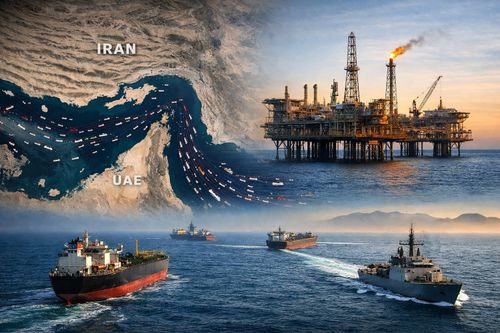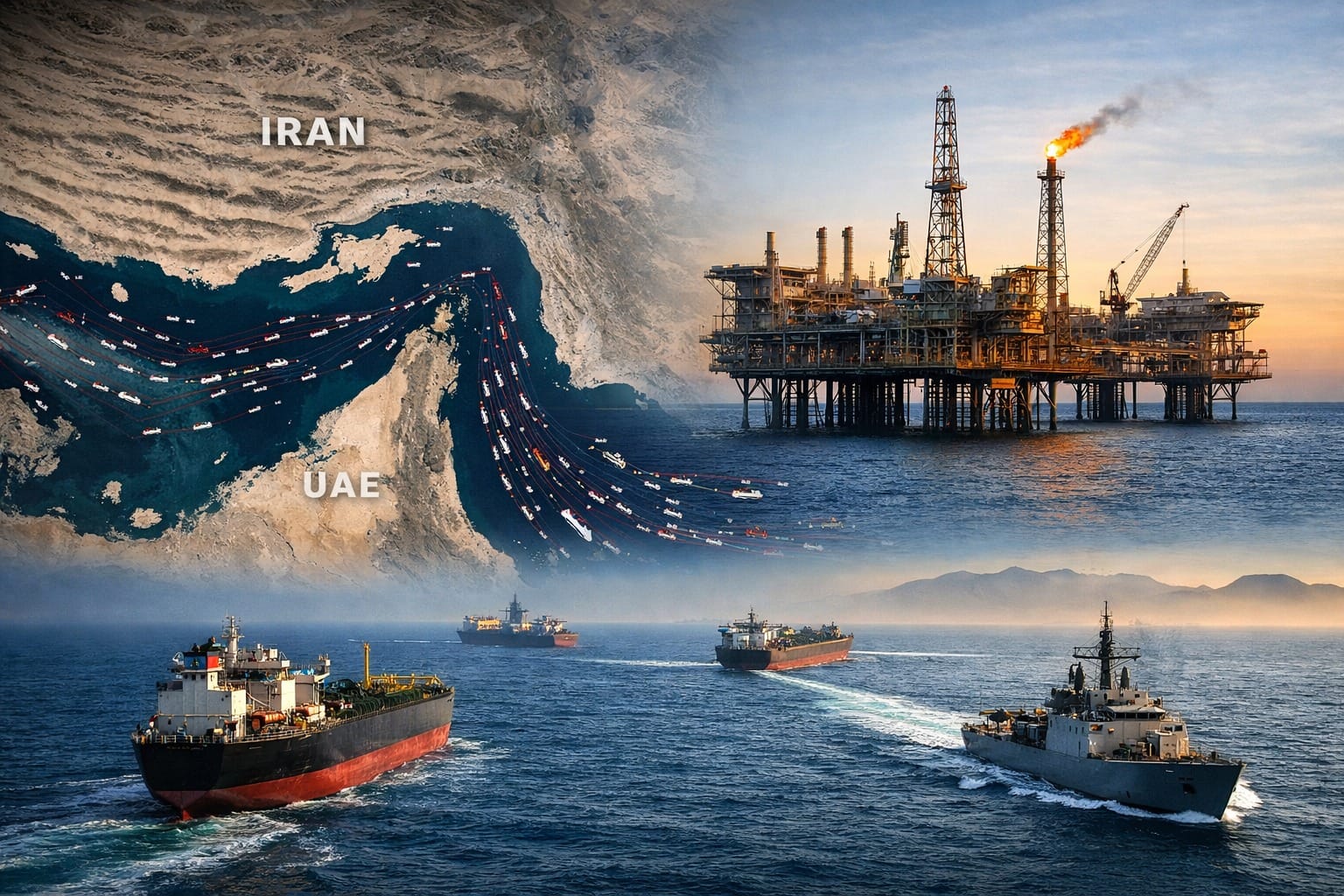




As I write this, more than two thousand ships and twenty thousand mariners remain stranded across the Persian Gulf. Iran’s parliament speaker has declared that reopening the Strait of Hormuz is impossible while the US naval blockade of Iranian ports holds. Ship traffic through the world’s most important energy chokepoint is running at a fraction of its pre-war level. Rystad Energy’s latest assessment, published last week, projects that oil flows will return to 90 per cent of pre-war levels only in July — and that the barrels which do begin moving will take another two months to reach refineries. The Atlantic Council is now openly advising governments to prepare for fuel rationing.
But the collapse of the Strait of Hormuz is a diagnostic. What we are witnessing is the release phase of the industrial energy system’s adaptive cycle — the moment at which a civilisational architecture built on one kind of energy begins to dismantle itself, because the operating conditions that sustained it have shifted. The commentariat is calling this an energy shock. It is more accurate to call it an unveiling of a dying system.
A better lens than the daily headlines
To see what is happening, we need a better lens than the news cycle. For several years I have been developing a framework to make sense of the convergence of climate, energy, economic, geopolitical and political stresses that policymakers now euphemistically call the “polycrisis.” I published the full version of this framework in late 2024 as a peer-reviewed paper in the journal Foresight, titled ‘Planetary phase shift’ as a new systems framework to navigate the evolutionary transformation of human civilisation. It builds on the adaptive cycle concept developed by the ecologists Crawford Holling and Lance Gunderson.
The adaptive cycle describes how complex living systems — forests, economies, civilisations — move through four phases. They grow, exploiting abundant resources. They enter conservation, becoming highly optimised, efficient and therefore rigid. When conditions shift, they enter release, in which accumulated structures break down faster than institutions can absorb. And finally they enter reorganisation, where what was broken is reassembled on different foundations.
A forest in its conservation phase appears stable, abundant, dominant. It is also maximally vulnerable to fire, because every niche has been filled and every redundancy trimmed away in the service of efficiency. When the fire comes, it moves fast. That is what release looks like from inside: a system whose long efficiency has traded away its resilience, now meeting a shock larger than its capacity to absorb.
Global industrial civilisation as a whole has entered this release phase. Hormuz is one of its most visible expressions.
The thermodynamic driver
The deepest reason lies in physics. Every energy source has a ratio called Energy Return on Investment — EROI — which measures how much usable energy you get back for each unit you put in. When the energy cost of getting energy is small, surplus is large, and you can afford everything else a civilisation does with that surplus: hospitals, factories, harvests, courts, schools, pensions. When the energy cost of getting energy rises, your surplus shrinks — and with it the civilisational capacity that surplus was silently sustaining.
Global fossil fuel EROI peaked in the 1960s at around 44:1. Since then it has been in slow, inexorable decline. A 2019 study in Nature Energy, by Paul Brockway and colleagues at the University of Leeds, found that when you measure at the point where energy actually reaches society — at your plug, your pump, your meter — global fossil fuel EROI is down to roughly 6:1 and still falling. French researchers have gone further: by 2030, the global oil industry is projected to consume a quarter of the energy it produces just to keep producing. By 2050, around half.
The 1973 analogy breaks down
The most common comparison — the 1970s oil shocks — is actively misleading. When OPEC imposed its embargo half a century ago, the underlying resource base was rich. Production could be expanded; alternative suppliers could be brought online; the shock could be managed by the logic of more. The solution matched the shape of the problem.
The current rupture is fundamentally different. The 5.3 million barrels per day of spare capacity that OPEC theoretically holds — the global system’s one remaining cushion — exports exclusively through the Strait, now closed due to the war.
Meanwhile US shale, which delivered roughly 90 per cent of global oil supply growth since 2015, has plateaued. The US Energy Information Administration’s own Short-Term Energy Outlook projects US crude production declining in 2026 for the first time in five years.
The IEA’s recent field decline-rates study finds that almost 90 per cent of upstream investment since 2019 has gone to offsetting decline in existing fields rather than expanding production. The global industry was already running to stand still before the crisis.
Even a ceasefire tomorrow would leave the damage already inflicted intact. Qatar’s Ras Laffan LNG complex, struck in the Iranian missile strikes of 18-19 March, will take three to five years to rebuild — because the specialist gas turbines required sit behind global order backlogs of two to four years. This means there is a structural permanence to this crisis that will redefine not just regional geopolitics, but the entire global economy, for years to come.
Synchronous failure, from 2002 to 2026
There is one more reason to insist that this is release, as distinct from disruption. In 2002, the renowned systems analyst Thomas Homer-Dixon gave a now-celebrated lecture at George Washington University in which he laid out the structural dynamics behind civilisational collapse. He called the dynamic synchronous failure: the condition in which multiple stresses building separately beneath the surface of a complex society are simultaneously activated by a single trigger, producing cascades that exceed any single institution’s capacity to absorb.
What Homer-Dixon described as a scenario is now operational in the Iran War. Consider what is already in train. The same Gulf disruption pushing up British energy bills has shut down the Qatar Fertiliser Company — the world’s largest single producer of urea — just as farmers across the Northern Hemisphere were preparing to plant. Fertiliser that was never applied in March and April means smaller harvests this autumn, and unstoppable food-price rises through winter 2026 and into 2027. University of Bonn economist Matin Qaim assesses that if current fertiliser prices hold, global food prices could rise by 20 to 30 per cent.
The same shock is degrading pharmaceutical supply chains. Generic medicines — the drugs most of us take most of the time — constitute 85 per cent of NHS prescriptions and operate on margins too thin to absorb sustained freight cost increases now running 45 per cent above pre-war levels. Within months, medications for chronic cardiovascular, diabetic and psychiatric conditions may cease to be commercially viable to supply at current costs. These are the daily medicines on which millions of people depend.
The same petrochemical disruption is accelerating the collapse of European industry. UK chemical output had already fallen 30 per cent from 2019 before the war began. Germany’s had fallen 18 per cent. Grangemouth, Britain’s last major ethylene cracker, is on government life support. Facilities closing under current cost structures stay shut. The industrial base on which any future recovery would have to build is being permanently hollowed out.
And above all of this, the fiscal and monetary instruments that cushioned the 2022 shock are disabled. The Treasury spent over £100 billion supporting households through the last crisis; that headroom is gone. Rising inflation rules out rate cuts at the Bank of England; rising rates push up mortgage costs for households already absorbing higher energy and food bills. Both instruments that governments normally use to absorb a shock have been crunched at once.
This is one systemic fracture presenting itself simultaneously through five channels — energy, food, industry, pharmaceuticals, public finances.
Want deeper insights? Get access to detailed macrointelligence, scientific white papers, and investor briefings by subscribing to premium...
The ratchet
There is a mechanism underneath all of this which makes each successive crisis worse than the last. Every shock consumes the buffers that would have absorbed the next one. Savings deplete. Fiscal headroom narrows. Institutional trust erodes. Political coherence fragments under the distributional pressures that energy and food prices generate. Homer-Dixon calls this the ingenuity gap: the widening distance between the scale of what is unfolding and the institutional capacity available to respond.
In 2022, following Russia's invasion of Ukraine, the shock was large and every buffer was still available. The system buckled but held. In 2026, the shock is larger, every buffer is depleted, and each failing system degrades the environment in which every other system must operate. This is what it means for a civilisation to enter release: the reflexes that absorbed the last shock have been used up.
What this demands, and what comes next
The question before UK and European policymakers is whether they recognise the shape of what is happening in time to act on it, or whether each transmission channel is again managed in isolation, consuming institutional capacity while the system that produced them remains untouched.
The instinct — the reflex of a century that worked — will be to answer the Hormuz shock with more hydrocarbons. North Sea licensing. LNG expansion. New nuclear. A revival of the extractive logic that built the modern world. This is the instinct we will examine in the next instalment. We will show why each of these responses fails the test of the release phase, and why the thermodynamic floor beneath them lies beyond the reach of that logic.
The instalment after that will turn to the reorganisation phase — the fourth stage of the adaptive cycle, which every release phase contains within it. The signals that this stage has already begun are measurable.
A February 2026 international scientific review involving more than 25 expert teams across four continents has confirmed that a fully renewable, firm, around-the-clock electricity system is both technically achievable and economically competitive. Countries that choose to enter this stage first will find themselves with lower energy bills, sovereign industrial capacity, and regain what energy politics lost fifty years ago: surplus.
That is the exit: a route already specified, costed, and being built.
This series draws on a new working paper co-authored with the Club of Rome’s Earth4All initiative — Electrified Sovereignty as Solution to Iran War Energy Shock — with Divyesh Desai (formerly Shell), Sandrine Dixson-Declève (Earth4All), Vicente López-Ibor Mayor (formerly Lightsource BP) and Gerard Reid (Alexa Capital, World Economic Forum Future Energy Council). A compressed version of the argument appears in Byline Times. This series develops the analytical framework underlying both.
If you appreciated this piece, sign up to get this newsletter delivered straight to your inbox for free. Or join premium to get access to deeper insights, white papers, scientific research and macrointelligence reports
Already have an account? Log In