


An integrated analysis of the UN Production Gap Report 2025 through the lens of reserve economics, capital allocation risk, and system dynamics
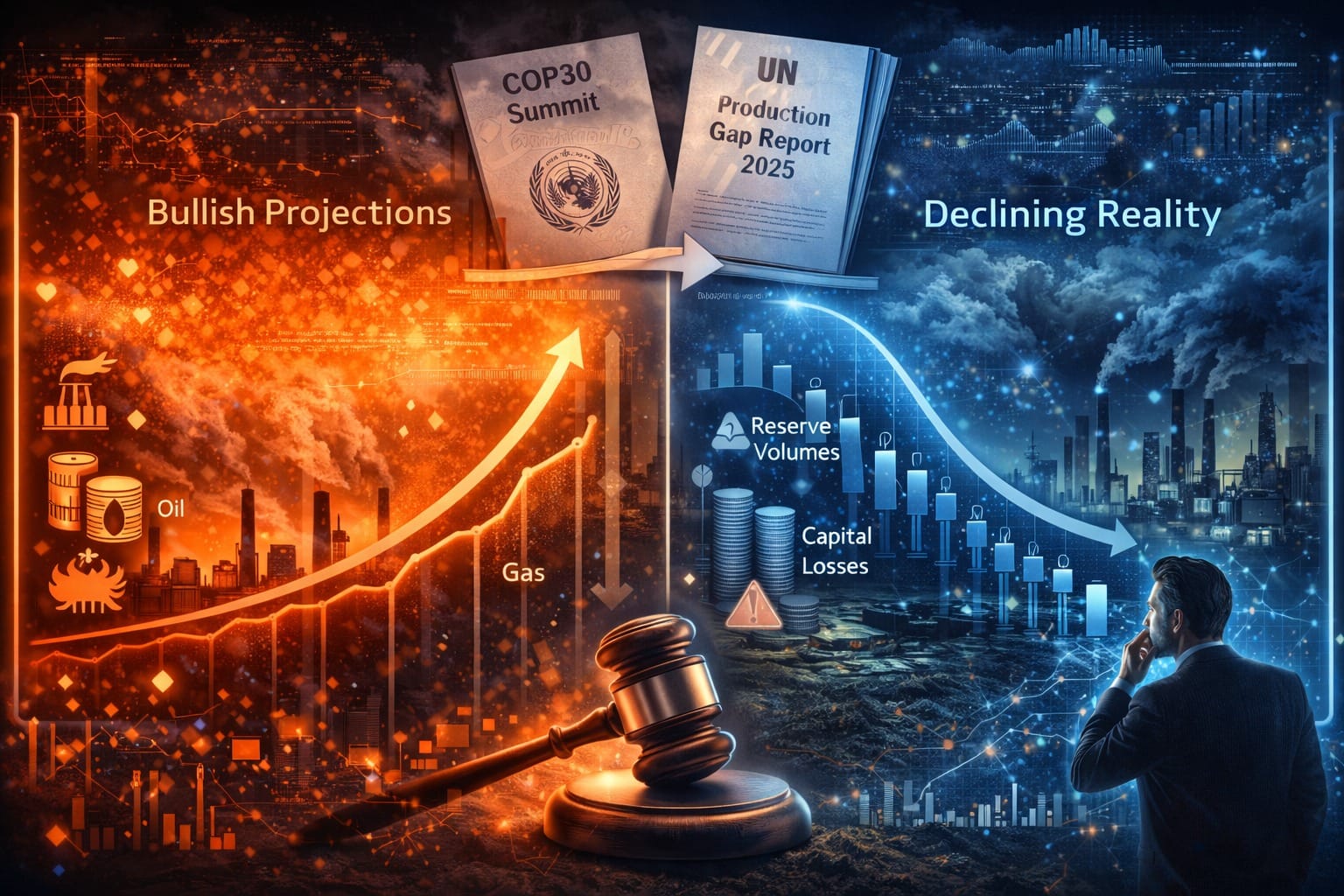
The UN's Production Gap Report 2025, published shortly before this year's lacklustre COP30 summit, draws on bullish industry projections assuming governments can ramp up coal, oil and gas through mid-century. In reality, underlying production data, reserve economics, and the capital performance of major projects tell a different story: a brief surge this decade, then structural limits that lock the fossil fuel era into managed decline with profound implications for how international oil companies, national oil companies, investors, and policymakers should assess capital allocation and strategic risk.
I. The paper boom: What production gap 2025 shows and doesn't ask
According to the latest United Nations Production Gap Report 2025, the world is on track for a fossil fuel boom that blows past anything compatible with the Paris Agreement (UNEP et al., 2025). If governments follow their own plans and projections, coal, oil and gas production in 2030 will be more than double the level consistent with a 1.5°C pathway, and around three-quarters higher than a 2°C-compatible trajectory.
The report profiles twenty producer countries from the US, Saudi Arabia and Brazil to India, Russia, Australia, Canada and Colombia that together account for roughly 82% of global fossil output. For each, it assembles the country's Government Plans and Projections (GPP): national energy strategies, company plans, official modelling and benchmark scenarios. The result is stark- nearly every government wants to keep ratcheting up extraction.
On paper, the US is still expanding its shale and LNG frontier. Saudi Arabia's hydrocarbons rise through the 2030s. Brazil doubles gas production. India and Russia push coal to new highs. Even as advanced economies talk net zero, the aggregate story is that the fossil age is gearing up.
Here's the uncomfortable question for boardrooms, treasury departments, and investment committees: If we stop worrying about climate goals for a moment and simply ask-can these production paths actually be delivered out to the 2040s and 2050s in the real world? what does the evidence say?
The missing questions that matter for capital
Production Gap 2025 is rigorous in documenting what governments plan. What it doesn't systematically interrogate is whether those plans are internally plausible once you account for:
Geological reality: Not just reserve volumes, but reserve quality, field maturity, decline curve dynamics, and the difference between proven (1P), probable (2P), and possible (3P) reserves distinctions that often blur in government projections but matter enormously for capital risk.
Net energy economics (EROI): The ratio of energy delivered to energy invested. As this declines and it has been declining across fossil fuels for decades, a rising share of gross output gets consumed by the energy sector itself, squeezing margins and project economics (Ahmed, 2017; Ahmed, 2024).
Market structure shifts: The rapid emergence of solar-wind-battery systems, electric mobility, and other disruptive technologies that erode fossil demand along S curves rather than gradual linear declines (Arbib and Seba, 2021).
Historical track record: How often have NOCs and IOCs committed tens of billions based on overly optimistic projections, only to face write-downs and stranded assets?
When you overlay these realities onto Production Gap's GPP pathways and check them against producers' own technical outlooks like EIA's Annual Energy Outlook 2025, the Canada Energy Regulator's Energy Futures 2023, Saudi Aramco's capacity decisions, Petrobras' business plans: a different picture emerges. One of front-loaded surges that peak in the late 2020s to early 2030s, followed not by sustained growth but by plateau and descent.
This is a fiduciary question. Over the past two decades, we have seen repeated cases where major producers committed vast capital based on flawed assumptions about reserves, decline rates, or long-term demand only to face value destruction. The Production Gap's GPP pathways, read uncritically, risk becoming the next generation of capital allocation mistakes.
Let's examine the evidence, starting with the two pillars of any fossil super cycle narrative: the United States and Saudi Arabia.
II. The US shale plateau: Peak oil hiding in the federal data
What the official numbers actually show
In the US country profile, Production Gap 2025 constructs a pathway showing crude oil and condensate output rising through the late 2020s, with 2030 production higher than 2023, declining only slowly towards mid-century. This places the US at the centre of the global expansion narrative - a durable shale and LNG superpower well into the 2040s.
The problem? Washington's own long-term outlook quietly contradicts that story.
The US Energy Information Administration's Annual Energy Outlook 2025, a mainstream reference case used by investors and planners is blunt in its projections (EIA, 2025):
- US crude oil and condensate production peaks around 2027 at roughly 13.9 million barrels per day
- Production then declines steadily to about 11.2 mb/d by 2050
- Even in high-price sensitivity cases, extra growth is modest and short-lived
- No core scenario shows US crude production rising continuously into the 2040s
Current data confirms we are already in the peak window. EIA statistics show US production at around 13.8 mb/d by late 2025-a record high, but exactly where AEO2025's plateau is supposed to be. From here, the official expectation is not another decade of expansion, but a long, uneven descent.
For capital allocators, this creates a critical timing problem. If you are underwriting upstream capex or midstream infrastructure assuming continued US production growth through the 2030s and 2040s, you are betting against the federal government's own technical assessment and against the geological realities underpinning it.
Want deeper insights? Get access to detailed macrointelligence, scientific white papers, and investor briefings by subscribing to premium...
Already have an account? Log In
The geology behind the numbers: Why tier-1 is running out
The AEO curves are not arbitrary. They encode something fundamental about US shale. The first decade of the revolution harvested the best rock in the most prolific basins: Bakken sweet spots, Eagle Ford core, Tier-1 Permian inventory. Today, that core inventory is visibly thinning.
Operators can still push headline volumes higher by drilling more wells, faster but they are increasingly running what's known as the Red Queen race: expending more capital and energy just to stand still (Ahmed, 2017; Ahmed, 2024).
Two dynamics define this late stage system:
Falling well productivity: As sweet spots fill up and new wells cannibalise pressure from existing ones, average initial production per well plateaus or falls. Independent analysis from Rystad Energy and Wood Mackenzie confirms that Tier-1 Permian locations are being exhausted faster than previously modelled, with new drilling pushing into Tier-2 and Tier-3 acreage requiring higher break evens and delivering shorter well life.
Declining EROI: Tight oil has an energy return on investment estimated at 5:1 or lower for marginal Permian wells, compared to 20-30:1 for legacy conventional fields (Ahmed, 2017; Ahmed, 2024). This matters because declining EROI means a growing share of extracted energy is consumed internally by drilling rigs, fracking fleets, water handling, pipelines, compressors leaving less net energy for the economy and squeezing project economics.
The capital implication: Projects that looked economic at $70-80/barrel when Tier-1 inventory was abundant now require $85-95/barrel in Tier-2/3 zones. At the same time, post2020 shareholder pressure for capital discipline has intensified. The result is a system that can sustain a high plateau briefly, but only at rising capital intensity and greater vulnerability to price swings.
The shale sector's own behaviour validates the depletion story
It's instructive to examine how US shale operators themselves have responded. After the 2014-2016 price collapse and 2020 COVID shock, investor sentiment shifted dramatically. Where operators previously prioritised production growth at any cost, they were forced by activist investors, debt covenants, and equity market punishment into a "capital discipline" model focused on free cash flow.
By 2022-2024, despite oil prices in the $75-95/barrel range that would previously have triggered a drilling boom, US production growth slowed markedly. Why? Because operators knew that drilling into Tier-2 acreage at scale would destroy returns. The industry's own restraint validates the depletion thesis.
For those evaluating US shale exposure whether through joint ventures, acquisitions, or infrastructure investments: the message is clear. The sector is entering plateau and decline. Capital deployed assuming continued growth is likely to generate subpar returns or outright losses. This is not a climate argument. It is geology and economics, confirmed by the sector's own behaviour.
Production Gap 2025's 2030 snapshot may be accurate. Its implied extension of growth beyond 2030 is not supported by either federal technical analysis or industry behaviour. Once you accept that the US is entering the late phase of its tight oil cycle, with peak production approaching and net energy eroding, the wider global expansion story starts to look shaky.
III. Saudi Arabia's strategic pivot: When the swing producer stops swinging up
The decision that changed everything
Between the 2023 and 2025 editions of the Production Gap report, something profound happened in global oil markets. On 30 January 2024, Saudi Arabia's energy ministry issued a directive instructing Aramco to abandon its plan to increase Maximum Sustainable Capacity (MSC) to 13 million barrels per day and instead maintain MSC at 12 mb/d (Aramco, 2024).
In other words: the kingdom cancelled its only significant capacity expansion project.
Aramco's statement was unambiguous: "Following a directive from the Ministry of Energy, Aramco will maintain its maximum sustainable capacity (MSC) at 12 million barrels per day, and no longer pursue its previous target of 13 million barrels per day."
Independent analysis from Fitch Ratings and Rystad Energy converged on the same interpretation (Fitch, 2024; Rystad, 2024): This decision reduces the medium term global supply buffer and signals that Riyadh no longer sees a compelling case for adding capacity at scale. Managing within a 12 mb/d ceiling allows Saudi Arabia to preserve long term reservoir health while maximising value in a market it expects to be structurally tighter and more contested.
This is a structural choice by the one producer that still has abundant, high quality conventional barrels: no more capacity growth.
What It signals about demand expectations
For anyone building long-term oil price models, upstream investment strategies, or refining capacity plans, this is beyond a footnote. it's a regime change.
Saudi Arabia has better market intelligence than almost any player. If they believed global oil demand was headed for robust, sustained growth through the 2040s, they would be expanding capacity to capture that upside. The fact that they're capping it at 12 mb/d reveals their internal assessment: demand will be flat to declining beyond the early 2030s, making further capacity additions economically irrational.
The competitive implications are stark. If Saudi Arabia with production costs around $10-15/barrel and some of the world's highest-quality remaining reserves won't expand capacity, what does that say about the economics facing higher cost producers? It suggests that new upstream investments in $40-60/barrel breakeven projects (offshore West Africa, Arctic, oil sands expansions) face severe risk of becoming stranded as the market tightens and Saudi maintains discipline.
Historical context: When the swing producer managed decline before
There's precedent here. In the 1970s-1980s, Saudi Arabia repeatedly expanded capacity in response to strong demand growth and geopolitical supply shocks, pushing capacity above 10 mb/d by the late 1980s. But in the 1990s-2000s, as non OPEC supply surged from the North Sea, Gulf of Mexico, and West Africa, Saudi Arabia didn't chase volume they managed within their capacity band, occasionally cutting production to support prices.
The current decision echoes that strategy in a more constrained context. Instead of facing competition from new conventional provinces, they are facing structural demand erosion from electrification and renewables. The message to the market is clear: the era of relying on Saudi expansion to accommodate ever growing oil demand is over.
Gas is a partial exception. Aramco is investing heavily in new gas projects, including unconventional resources like the Jafurah field. Production Gap 2025's assumption of higher Saudi gas output in 2030 is compatible with those plans. But even here, the long-run demand picture is shifting, with the IEA projecting global gas demand peaking in the 2020s or 2030s (IEA, 2024).
The realistic trajectory: short-term gas rise; oscillating but capped oil output; no structural increase in total hydrocarbon production beyond a 12 mb/d-equivalent envelope.
The capital allocation message
Put the US and Saudi stories together and a pattern crystallises:
- In the United States, the federal outlook shows a crude peak in the late 2020s, followed by decline. Shale geology, declining EROI, and capital discipline explain why.
- In Saudi Arabia, the state has voluntarily capped oil capacity rather than chasing a larger MSC.
These are the two pillars that any 2040s fossil super cycle would rest on. Yet both are signalling that the era of ever-rising oil production is over.
Production Gap 2025 is right to warn that current government plans would blow through climate budgets. But once you check those plans against producers' own outlooks, reserve realities, and strategic positioning, the "massive growth" in GPP curves looks far more like a front-loaded bulge than a durable new phase.
For capital allocators, the question becomes: Are you building portfolios and infrastructure around a mirage?
Want deeper insights? Get access to detailed macrointelligence, scientific white papers, and investor briefings by subscribing to premium...
Already have an account? Log In
IV. Other "growth engines": Brazil's peak, Canada's trap, Qatar's gamble
Once you move beyond the US and Saudi Arabia, Production Gap 2025 leans heavily on three other producers: Brazil's pre-salt surge, Canada's oil sands creep, and Qatar's LNG doubling. Here too, the reality is more complex and more revealing of capital risk.
Brazil: A real surge with a visible ceiling
Brazil's story is genuine in the near term. By 2024, production had passed 3.6 million barrels per day, with pre-salt fields comprising over 75% of output (ANP, 2025). Petrobras' 2024-2028 Strategic Plan commits $73 billion to upstream, with 67% allocated to pre-salt (Petrobras, 2023).
But Petrobras itself isn't projecting endless growth. A 2026-2030 business plan reported by Reuters projects peak output of 2.7 mb/d oil and 3.4 mboe/d total in 2028-29, followed by plateau rather than continued growth (Reuters, 2025a).
From a capital perspective, Brazil's pre-salt is a mixed story. The reservoirs are genuinely world-class, with EROI in the 8-10:1 range-better than oil sands (3-5:1) or tight oil (5:1). But deepwater development requires FPSOs, subsea infrastructure, and long lead times, with all in break evens typically $40-50/barrel. As development moves from discovery wells to infill drilling, per-well productivity is declining visible in ANP data showing rising capex per incremental barrel.
The Libra field consortium Petrobras, Shell, Total, CNOOC, CNPC illustrates these dynamics. The $20+ billion project has faced cost overruns, schedule delays, and lower-than-expected productivity from some wells. Shell, in its 2022 strategy update, signalled it would prioritise capital discipline over volume growth in deepwater implicitly acknowledging that even world class pre-salt projects face margin pressure as easy barrels are produced first.
The lesson: Pre salt success is front loaded. Brazil's 2020s surge is real and based on committed projects. But treating 2028-30 as a stepping stone to higher 2040s output requires believing in sustained $70+ prices or technological breakthroughs -neither assured.
Canada: The oil sands capital trap
Canada's profile shows production rising modestly through the 2020s and remaining high into the 2040s. But the Canada Energy Regulator's own Energy Futures 2023 tells a different story (CER, 2023):
- In the Current Measures case (existing policies, no extra climate ambition), crude production grows into the early 2030s then declines to around 3.9 mb/d by 2050, roughly 22% below 2022 levels
- In climate-aligned cases, production falls more sharply after 2030
The regulator's baseline is that Canadian oil production will not be higher in 2050 than today.
From an EROI and capital efficiency perspective, oil sands are among the most challenged resources globally. EROI of 3-5:1 means that for every 5 units extracted, 1-2 units are consumed in extraction, upgrading, and transport (Ahmed, 2017). High capital intensity-massive upfront investment in mining operations or continuous SAGD steam injection creates all in break evens of $60-70/barrel, at the high end of the global cost curve.
The Teck resources frontier mine debacle is instructive. The proposed 260,000 b/d project received government approval in 2020 after a decade long process. But Teck withdrew its application weeks later, citing "the broader context of climate change" and acknowledging that project financing had become untenable (Teck, 2020).
This was a $20 billion project with regulatory approval, everything producers supposedly need-yet it died because capital markets refused to back it. Why? Because institutional investors increasingly saw oil sands mega projects as uneconomic in a carbon-constrained, demand-declining future.
The lesson: Even in stable Canada, with clear property rights and world-class infrastructure, high-cost, low-EROI oil sands projects struggle to attract capital. Production Gap's assumption of continued Canadian growth beyond 2030 runs counter to this capital markets reality.
Qatar: Real LNG growth into oversupply risk
Qatar's North Field expansion is very real. Qatar Energy will raise LNG output from 77 million tonnes per annum to 126 mtpa by 2027, reaching 142 mtpa by 2030 (Reuters, 2025c). The North Field is the world's largest non-associated gas field low-cost, high-productivity, with decades of life at current rates.
The constraint is not supply but demand at high price. Multiple analyses now warn of LNG oversupply emerging by 2027-2030:
- Wood Mackenzie projects planned LNG capacity additions will outpace demand growth, potentially creating 100+ mtpa surplus by 2030, depressing spot prices and threatening higher cost projects
- Rystad Energy estimates that if all sanctioned projects come online, global utilisation could fall to 80-85% by 2030, below the 90%+ needed for investment returns
- The Middle East Council warns Qatar is "threading the needle" between expansion and market saturation (MEI, 2024)
For LNG buyers and infrastructure investors, this creates a paradox. Qatar's expansion is geologically and technically sound, but the market may not absorb all new supply at remunerative prices. Long-term contracts signed today at $12-15/MMBtu may look expensive if spot markets trade at $6-8/MMBtu through the 2030s.
TotalEnergies' Mozambique LNG project provides a cautionary parallel. Despite world-class resources, the project which reached FID and started construction was suspended indefinitely in 2021. Beyond security issues, it faced escalating costs, and growing doubts about competing in an increasingly crowded market.
The message for Qatar's partners (Shell, TotalEnergies, ConocoPhillips, Eni): Even low-cost LNG faces market saturation risk. Qatar's expansion will proceed because it's state-backed and under construction, but returns may disappoint if the 2030s market is oversupplied.
The pattern across Brazil, Canada, and Qatar is consistent: Genuine near-term growth backed by committed capital and visible projects, but trajectories that resolve into front-loaded surges rather than multi-decade expansion. More critically, capital deployed in these "growth engines" faces significant downside risk from demand erosion, market oversupply, and maturing alternatives.
V. Coal's terminal decline: One real boom, three paper tigers
On coal, Production Gap 2025 claims India, Russia, Australia and Colombia are ramping up mining, prolonging the global phase-out. The reality: India yes, for now. The others are already colliding with economic walls. More importantly, this is a story that has repeatedly led to stranded capital in coal over the past decade.
India: Real growth to 2030, doubtful beyond
India is genuinely in a coal boom. Ministry of coal data shows output reached 1,047.69 Mt in 2024-25, up 11.7% year-on-year (Ministry of Coal, 2025a). Coal India Limited targets over 1 billion tonnes by 2028-29 (Coal India, 2024). The push toward 1.3-1.5 billion tonnes around 2030 is consistent with current policy and committed investment.
But the further vision 75 Bt in 2047 faces mounting constraints:
Infrastructure bottlenecks: Rail logistics are a documented constraint. India's coal transport system operates near capacity; expanding it requires massive public investment that may not materialise if renewables displace demand faster than expected.
Renewables economics: India's solar LCOE has fallen to ₹2-2.5/kWh (~$0.025-0.03/kWh), well below new coal at ₹3.5-4/kWh (IEA, 2024; CPI, 2023). Battery storage costs are falling 15-20% annually, further eroding coal's position.
IEA and independent modelling increasingly point to Indian coal demand peaking in the 2030s, not rising linearly to 2047. The capital risk: Thermal coal plants commissioned in the late 2020s face significant stranded asset risk if demand peaks mid-2030s. International banks and development finance institutions are increasingly reluctant to fund new coal capacity in India, forcing greater reliance on domestic sources.
Russia: A sector in crisis, not expansion
Russia's long-term programme envisions coal production rising from 430 Mt today to 530 Mt by 2030 and 662 Mt by 2050, increasing export share from 11% to 25% by 2035.
The ground reality is opposite. Loss of European markets after 2022, sanctions on logistics, and rising rail tariffs have pushed Russia's coal sector into what industry figures call its worst crisis in three decades:
- Aggregate losses of ~225 billion roubles in the first seven months of 2025
- At least 23 companies closed, 50+ at risk
- Export volumes squeezed by limited eastward rail capacity and steep Asian discounts (Reuters, 2025d; Kommersant, 2025)
Mechel, one of Russia's largest coal and steel producers, illustrates the dynamic. Heavily reliant on European coking coal exports, Mechel faced immediate distress when sanctions cut those markets in 2022. Share price collapsed 90%+, the company defaulted on international bonds, and was forced into debt restructuring that wiped out equity. Production was curtailed at multiple mines as export logistics became uneconomic.
The lesson: Even world-class, low cost coal becomes stranded when export markets disappear and alternatives don't provide sufficient margins. Russia's coal sector is discovering that "just ship to Asia" isn't viable when Asian buyers demand 20-30% discounts and rail capacity east is constrained.
Australia: Peak coal in government data
Australia appears in PG2025 as "ramping up." But Geoscience Australia's own assessment concludes coal production declined 4% in 2022-23 (Geoscience Australia, 2025). The Department of Industry's Resources and Energy Quarterly shows thermal coal exports peaking mid-2020s, then declining through 2030 (DISR, 2025).
Whitehaven coal's Vickery extension illustrates the cost escalation dynamic. After securing all approvals and taking FID in 2022, the project has faced repeated delays and cost overruns. Initial capex of A$700 million has blown out to over A$1 billion. Project financing required higher-than-market returns to attract debt, reflecting bank concerns about long-term demand. First coal, originally expected in 2023, is now pushed to 2026-2027.
The point: Even with approvals and FID, combination of rising costs, financing constraints, and uncertain long-term markets makes new coal projects increasingly uneconomic. Australia is experiencing high cost, slow motion wind down masked by short-term price volatility.
Colombia: Active contraction
Colombia, historically Latin America's largest coal exporter, has been upended by European demand collapse and price volatility. Cerrejón, the giant mine that once produced 20+ Mt annually, is cutting production to 11-16 Mt: a reduction of 5-10 Mt annually, citing weak seaborne prices and high transport costs (Glencore, 2025; Reuters, 2025f).
Glencore's Cerrejón wind-down is particularly instructive. This was once seen as a low-cost, long-life asset with decades ahead. But by 2024-2025, Glencore one of the world's most sophisticated commodity traders, was actively winding down production. Why?
- European phase-out eliminated high-value markets
- Redirecting to Asia meant competing with Indonesian, Australian, and Russian suppliers closer to buyers and often lower cost
- Social and environmental pressure escalated operating costs and reputational risk
Even world-class, low-cost coal assets become stranded when export markets disappear. Glencore is walking away from Cerrejón because the economics no longer work-a clear signal to anyone evaluating coal investments in export oriented jurisdictions.
The coal pattern reinforces everything we have seen in oil and gas: India is genuinely expanding to 2030, though mid-century targets are doubtful. Russia, Australia, and Colombia are colliding with constraints making PG2025's "ramp-up" language untenable. In Russia and Colombia, the sector is in active contraction.
For those with coal exposure: Thermal coal's terminal decline is present market reality. Capital deployed in coal today faces high probability of value destruction.
Want deeper insights? Get access to detailed macrointelligence, scientific white papers, and investor briefings by subscribing to premium...
Already have an account? Log In
VI. Why the numbers don't add up: EROI, Disruption, and System Dynamics
We've treated Production Gap 2025 as a fact checking exercise against producers' own data. But there's a deeper structural reason these pathways overshoot that matters critically for capital allocators.
We are living through the late conservation / early release phase of the fossil-fuelled industrial system (Ahmed, 2017; Ahmed, 2024). Three dynamics are colliding
The Net energy squeeze
The energy return on investment (EROI) of fossil fuels has been trending down for decades (Court and Fizaine, 2017; Brockway et al., 2019). Global average fossil EROI has roughly halved since mid-20th century. The oil sector's own share of final energy consumption is on track to reach 25% by 2030 and potentially 50% by 2050 under business as usual (Ahmed, 2024).
This matters because it constrains net energy flow even if gross production rises. US shale, Canadian oil sands, deepwater pre-salt, remote coal-the "growth" plays underpinning PG2025 sit at the low end of the EROI spectrum. They're the fuels of a civilisation that has used up the easy stuff.
Commercial implication: Projects with EROI below 5:1 faces a structural headwind. As they scale, increasing shares of energy produced must be reinvested to maintain output, leaving less net energy for buyers and squeezing margins. This appears as rising capital intensity (more capex per barrel), higher operating costs (more energy inputs required), and greater price sensitivity.
For capital allocators: EROI is profitability and sustainability matric. Low EROI projects can be profitable at high prices, but they are first to become uneconomic when prices soften or carbon costs rise.
Demand disruption following S curves, not lines
Fossil demand isn't eroding along smooth linear paths. Technologies follow S curves, displacing incumbents far more quickly once they cross cost and capability thresholds (Arbib and Seba, 2021).
Solar wind battery and grid scale storage enable near marginal cost electricity, undermining coal and gas in power. Electric vehicles are eating into oil demand for road transport. These are new production systems (Ahmed, 2024).
Mainstream institutions like the IEA have repeatedly underestimated these curves (Grubler et al., 2018). Production Gap 2025 inherits those conservative assumptions via reliance on IEA and OPEC reference cases.
The parallel: In the 2000s, Nokia and Blackberry dominated mobile phones with 40% market share. Within 5 years of the iPhone's launch, both were out of smartphones. The transition wasn't linear; it was an S curve. Fossil fuels in power and transport face similar dynamics, just on longer timescales.
For infrastructure investors: Projects with 20-30 year paybacks (LNG terminals, oil sands mines, coal plants) are betting demand curves won't inflect sharply. Even if you don't believe in rapid disruption, prudent strategy demands shorter paybacks and higher hurdle rates to compensate for demand risk.
Late phase planning habits
Late in a regime's life cycle, incumbent actors project recent experience forward, assuming growth can be maintained with more investment and marginal improvements. They produce plan heavy scenarios maintaining appearance of control even as dynamics shift (Holling, 2001; Ahmed, 2017).
Government energy strategies and corporate plans, the backbone of PG2025's GPP are products of this culture. They downplay depletion and EROI issues, assume manageable gradual demand declines, underestimate disruptive alternatives, and embed political aspirations into what are presented as neutral "projections."
Venezuela's Orinoco belt provides the template. With over 300 billion barrels of heavy oil reserves, successive governments and PDVSA published plans showing production rising to 4-5 mb/d by the 2020s. The result: production collapsed from 3.5 mb/d in 1998 to under 500,000 b/d by 2024. Projects were abandoned, foreign partners (Chevron, Total, Statoil, ENI) lost billions.
The mistake: Treating PDVSA's plans as credible forecasts rather than political aspirations disconnected from geological reality, capital requirements, EROI constraints, and market conditions.
The same caution should apply today. Production Gap GPP pathways represent what governments want or say they will do. Experienced investors discount those statements against geological reality, capital requirements, EROI constraints, and market trends before committing funds.
VII. Strategic implications: reading the production gap as an upper bound
If we synthesise this analysis, the picture that emerges is clarifying and actionable.
The Production Gap is real in the climate sense. Combined GPP pathways are far above anything compatible with 1.5°C or 2°C. But when tested against producers' own outlooks, production data, reserve economics, and structural constraints, a different reality asserts itself:
- The US can sustain a high oil/gas plateau to ~2030, but AEO2025 and shale depletion point to decline thereafter
- Saudi Arabia has capped oil capacity at 12 mb/d, voluntarily exiting expansion
- Brazil and Qatar show genuine near term growth, but their own plans frame 2028-2030 as peak/plateau, not 2050 boom
- Canada's regulator expects 2050 oil production below 2022 levels
- On coal, only India looks like a real growth engine to 2030; Russia, Australia, Colombia face constraints making ramp up untenable
The simplest reconciliation: treat PG2025 GPP as an upper-bound stress test representing what governments want to do if demand stays robust, capital flows, and physical constraints don't bite hard. In practice, expect front loaded surges, messy plateaus, then descent and stranded assets, especially in low EROI, high cost segments.
For capital allocators and risk managers
Investors, insurers, and sovereign analysts taking PG2025 expansion curves at face value will misprice both risk and opportunity:
They will underestimate risk of:
- Stranded fossil assets: projects commissioned late 2020s-early 2030s may operate in structurally lower demand/price markets
- Debt distress: producer countries whose budgets assume growth that doesn't materialise face revenue shortfalls, potential defaults
- Write-downs: NOCs and IOCs with portfolios concentrated in high-cost, low-EROI assets face repeated revaluations
They will underestimate opportunity in:
- Disruptive systems: solar wind battery, electrified demand, emerging sectors (green hydrogen, sustainable aviation fuel) eating into fossil demand faster than linear scenarios assume
- Early mover advantage: those pivoting quickly capture disproportionate returns; laggards face commoditised, declining markets
Practical actions:
- Stress test portfolios against demand scenarios 20-30% below consensus by 2035
- Demand shorter paybacks (10-15 vs 20-30 years) for new fossil infrastructure
- Raise hurdle rates compensating for stranded asset and demand erosion risk
- Diversify aggressively into renewables, grid infrastructure, enabling technologies
- Engage governments and NOCs demanding more transparent, conservative forecasting
For transition planning and policy
Tempting to think that if GPP pathways are physically unrealistic, "the climate will save itself" that depletion and EROI will force managed decline without policy intervention. Wrong conclusion.
Physical and net energy constraints don't produce gentle declines. They produce crisis led adjustments: price spikes, fuel shortages, financial instability, political backlash.
The fact that US and Saudi are unlikely to sustain 2040s growth doesn't mean passive waiting works. It means expecting a decade or two of volatile, contested plateau where:
- Incumbents push hard to monetise remaining reserves
- States lean on fossil rents to manage social stress
- The window for building out new systems fast enough to cushion descent is narrow
Understanding the expansion mirage helps focus on leverage points:
- Accelerating solar, wind, battery, and grid integration deployment
- Demand side policies accelerating electrification in transport, heat, industry
- Financial system re orientation from fossil project finance to clean infrastructure
- Just transition planning in coal/oil-dependent regions before descent becomes crisis driven
- Buffer stock policies smoothing volatile transition without locking in new long-term supply
For reading future reports and engaging producers
This analysis suggests how to use future Production Gap reports more effectively and how IOCs, NOCs, and investors should interpret them.
Read GPP curves as:
- Map of incumbent fantasies: what governments and fossil incumbents would like, revealing strategic priorities and constraints
- Dataset for stress testing: which expansion parts are geologically/economically fragile (Russia coal, Colombia coal, US shale post-2030) vs robust enough to pose long lived risks (India coal to 2030, Qatar LNG, Saudi spare capacity)
- Starting point for phase shift aware scenarios: where EROI, disruption, reserve quality, and systemic fragility are core drivers, not afterthoughts
The central message is not that Production Gap 2025 is wrong. It is that, taken with producers' own data and a system dynamics lens, it tells an even starker story than intended:
We are not heading into a comfortable fossil super cycle. We're entering the turbulent backloop of a system that has overshot energetic and ecological limits-a period where the illusion of endless expansion collides with hard constraints of geology, net energy, market saturation, and time.
The task for capital allocators, policymakers, and strategic planners:
- Recognise the illusion: frontloaded expansion masking structural decline
- Price risk accordingly: demanding evidence of economic viability beyond political rhetoric
- Reallocate capital decisively: toward post carbon systems dominating 2030s 2050s energy
- Support orderly transitions: investing in workforce retraining, economic diversification, safety nets in fossil dependent regions before crisis forces chaotic adjustment
The window for proactive adaptation is narrowing. The evidence is clear. The choice is ours.
References
Agência Nacional de Mineração (Colombia). (2024). Fact sheet coal 12 2024. ANM.
Ahmed, N. M. (2017). Failing states, collapsing systems: Bio-physical triggers of political violence. Springer.
Ahmed, N. M. (2024). Planetary phase shift: Toward a macroecological theory of systemic risk, collapse, and renewal. Foresight.
Aramco. (2024, January 30). Aramco receives directive to maintain MSC at 12 million barrels per day [Press release]. Saudi Arabian Oil Co.
Arbib, J., & Seba, T. (2021). Rethinking climate change. RethinkX.
Brockway, P. E., Owen, A., Brand-Correa, L. I., & Hardt, L. (2019). Estimation of global final-stage energy-return-on-investment for fossil fuels. Nature Energy, 4(7), 612-621.
Canada Energy Regulator. (2023). Canada's energy future 2023. CER.
Climate Policy Initiative. (2023). The economics of coal versus renewables in India. CPI.
Coal India Limited. (2024). Production [Webpage]. Coal India Ltd.
Court, V., & Fizaine, F. (2017). Long-term estimates of the energy-return-on-investment (EROI) of coal, oil, and gas. Ecological Economics, 138, 145-159.
Energy Information Administration. (2025). Annual energy outlook 2025. U.S. EIA.
Fitch Ratings. (2024). Saudi Arabia's halted oil expansion. Fitch Ratings.
Geoscience Australia. (2025). Australia's energy commodity resources 2025: Coal. Australian Government.
Glencore. (2025). Annual report and sustainability review 2024. Glencore plc.
Grubler, A., et al. (2018). A low energy demand scenario for meeting 1.5 °C. Nature Energy, 3(6), 515-527.
Holling, C. S. (2001). Understanding the complexity of economic, ecological, and social systems. Ecosystems, 4(5), 390-405.
International Energy Agency. (2024). World energy outlook 2024. IEA.
Kommersant. (2025). Russian coal industry faces worst crisis in 30 years. Kommersant.
Middle East Institute. (2024). Qatar's LNG expansion plans and market oversupply. MEI.
Ministry of Coal (India). (2025a). Production and supplies. Government of India.
Petrobras. (2023). Strategic plan 2024-2028. Petróleo Brasileiro S.A.
Reuters. (2025a). Petrobras sees oil production peaking in 2029. Reuters.
Reuters. (2025c). LNG output from QatarEnergy's North Field expansion to start 2026. Reuters.
Reuters. (2025d). Russian coal miners face record losses. Reuters.
Reuters. (2025f). Cerrejón to cut coal production. Reuters.
Rystad Energy. (2024). Saudi Arabia's shifting sands. Rystad Energy.
Teck Resources. (2020). Teck withdraws regulatory application for Frontier Project. Teck Resources Limited.
United Nations Environment Programme, et al. (2025). The production gap report 2025. UNEP.