

Interpreting the commercial logic behind USA’s Iran gambit
Ten days into a conflict that has effectively shuttered the world's most critical energy chokepoint, Brent crude hovers around $97-98 per barrel. The number is striking but what it does not reveal is more telling. Oil is not settled above $100, despite the Strait of Hormuz being, to all practical purposes, closed.
The restrained price response tells us that the commercial logic behind America's Iran strategy is more structurally contested than the optics suggest. Iran holds the world's third-largest proven oil reserves and the second-largest natural gas reserves. The prize is real and so are the four decades of barriers that are not yet dismantled
This piece examines six interlocking dimensions of the Iran energy story: the scale of the hydrocarbon wealth and why it remains commercially trapped; the South Pars/North Dome asymmetry as the sharpest illustration of opportunity cost; the commercial logic and limits of American strategic ambition; the China dimension that American policymakers routinely understate; the mechanics of why oil has stayed below $100; and what the post-conflict IOC re-entry scenario actually looks like in contractual and financial terms. It concludes by placing the crisis within the broader energy transition context - the dimension most conspicuously absent from almost all current commentary.
For capital allocators, C suite executives, and policymakers navigating this moment: the questions that matter are: who controls what comes next, on what terms, at what cost, and whether the prize, by the time it is accessible, will still be worth the price paid to access it.
I. The prize: Iran's hydrocarbon wealth in commercial context
The numbers don’t lie. Iran holds an estimated 208 billion barrels of proven crude oil reserves which is approximately 13% of the global total, ranking third globally behind Venezuela and Saudi Arabia. Its natural gas reserves of 34 trillion cubic metres represent roughly 16% of the world's total, second only to Russia.1 These are civilizational-scale assets sitting largely inaccessible to global capital.
In production terms, Iran reached approximately 3.2 million barrels per day (bpd) by late 2025, a notable recovery from the sanctions-driven bottom of roughly 2 million bpd in 2020. Yet this remains far below Iran's pre-revolutionary peak of over 6 million bpd in 1974, and well below theoretical capacity of 3.8-4.0 million bpd that NIOC engineers have cited as achievable with adequate investment.2 The gap between reserves and actual output is not geological. Iran's fields - Ahvaz, Marun, Gachsaran, the giant West Karoun complex are well-characterised, extensively drilled, and in many cases producing since the 1960s.
The gap is the consequence of four decades of sanctions, capital starvation, and the systematic exclusion of international oil companies (IOCs) from Iran's upstream. Iranian crude typically trades at a $3-9 per barrel discount to Brent - effectively the price Tehran pays for maintaining a sanctions-constrained, limited customer base.3 That discount, at 2025 export volumes, costs Iran approximately $2-5 billion annually in forgone revenue. The opportunity cost of the current political settlement is calculable and enormous.
The gas dimension: South Pars and the tragedy of the commons
The sharpest measure of Iran's underperformance is South Pars, its slice of the world's largest gas field. The combined reservoir holds an estimated 1,800 trillion cubic feet of natural gas by any measure, the single largest gas accumulation on the planet.4 By any measure, it is among the most valuable single energy assets on the planet.
The commercial divergence between the two countries' exploitation of this shared reservoir is undeniable evidence of how political economy shapes energy outcomes. Qatar began aggressive development of its North Dome section in the early 1990s, partnering with TotalEnergies, Shell, and ExxonMobil to construct world-class LNG liquefaction infrastructure. By early 2026 just before Iranian drones struck Ras Laffan, QatarEnergy was producing approximately 77 million tonnes per annum (mtpa) of LNG from the field, making Qatar one of the world's largest LNG suppliers. Oil and gas revenues constituted approximately 80% of the Qatari government's income.56 Qatar has committed to expanding North Dome production from 77 to 126 million tonnes per annum (mtpa) by 2027, with projections extending to 142 mtpa by 2030.
Iran, by contrast, was producing an estimated 2 billion cubic feet per day from its South Pars section - a nine to one production asymmetry from a reservoir where Iran holds roughly one-third of the area.7 The cause is not insufficient reserves. Iranian production lags because sanctions have denied NIOC access to the 20,000-tonne offshore compression platforms required to maintain reservoir pressure as the field matures. Pressure on the Iranian side is declining at seven atmospheres per year, implying a production decline of approximately 10 billion cubic metres annually without intervention.
NIOC has acknowledged the urgency. In early 2026, Iran's Petroleum Ministry announced a $20 billion programme to construct 28 new offshore platforms and 56 compression units - an investment programme premised entirely on technologies Iran cannot currently procure. Meanwhile, the First Iran-Iraq War, the Revolution, and four decades of sanctions have collectively ensured that the upstream maintenance and EOR (Enhanced Oil Recovery) capability gap between NIOC and major IOCs is now approximately 25 years wide. The physics of reservoir management do not wait for geopolitical resolution.8 Iran is losing gas share from a jointly owned reservoir, in real time, because its political system has made it structurally dependent on technologies it cannot procure.
Want deeper insights? Get access to detailed macrointelligence, scientific white papers, and investor briefings by subscribing to premium...
Already have an account? Log In
II. The gambit: What operation Epic Fury was and wasn't
On February 28, 2026, US and Israeli forces launched coordinated airstrikes on Iran under Operation Epic Fury, targeting military infrastructure, nuclear facilities, and senior leadership including, reportedly, Supreme Leader Ali Khamenei. Within hours, Iran's Islamic Revolutionary Guard Corps (IRGC) broadcast VHF warnings across the Strait of Hormuz: no ships permitted to pass.9
The stated US objectives: destruction of nuclear capability, degradation of ballistic missile stockpiles, reduction of proxy network support, and possible regime change are the familiar fingerprints of American strategic ambition in the Middle East. What is notably absent from official communications is any coherent economic or energy rationale. This is understandable Commercial logic.
Consider the energy context that preceded the strikes. Iran's oil exports in 2025 averaged approximately 1.7 million bpd, almost entirely flowing to China via a shadow tanker fleet that systematically circumvented US sanctions. Iran was generating approximately $43 billion annually from hydrocarbon exports, funding a state apparatus that Washington considers hostile across multiple dimensions: nuclear, proxy warfare, and geopolitical alignment with China and Russia.10
The strategic logic of an attack, viewed through a commercial lens, is about restructuring who controls access to them. A post-conflict Iran under a compliant or reconstructed government would theoretically reopen the world's second-largest gas reserves and third-largest oil reserves to Western IOC participation. The prize is the reallocation of rent.
III. The China dimension: The strategic buyer nobody prices
Without confronting the China dimension, Iran's energy position is incomplete - the structural factor that American strategic communications have most consistently underweighted, and which the current conflict has brought into sharp focus.
China absorbed approximately 80% of Iran's seaborne crude oil exports in 2025, purchasing roughly 1.38 million bpd.12 The mechanism was a sophisticated, decades-refined sanctions evasion architecture: a shadow fleet of aging re-flagged tankers conducting ship-to-ship transfers off the coast of Malaysia; Chinese independent refineries (the 'teapot' refiners clustered in Shandong province) absorbing the crude at a $8-10 per barrel discount to Brent; yuan denominated and barter payment settlements that bypass the US dollar clearing system; and opaque financial conduits that reduce OFAC's interception capability.
In 2025 alone, shadow tankers made over 1,500 voyages from Iran to China.13 US OFAC sanctioned additional vessels and networks in February 2026 as part of a 'maximum pressure' campaign, but enforcement remained imperfect. The shadow fleet has grown more efficient over time. The US 'Operation Southern Spear', which seized at least ten tankers since December 2025, sent a deterrent signal but with limited commercial impact on overall volumes.14
The relationship is transactional with commercial significance. Iran supplies discounted barrels; China provides revenue. The crude is largely purchased by independent 'teapot' refiners operating on thin margins, not by China's largest state-owned enterprises. Of the $400 billion in Chinese investment envisioned under the 2021 Iran-China 25-year 'comprehensive strategic partnership', actual delivery has been, by most estimates, modest. Carnegie Endowment puts actual Chinese investment in Iran from 2005 to 2025 at just $4.7 billion. The main obstacle: Chinese firms' reluctance to risk secondary sanctions exposure with US counterparties.15
What the conflict has done is simultaneously expose China's vulnerability and eliminate the shadow channel. With Hormuz effectively closed, the ship-to-ship transfer infrastructure off Malaysia that supplies Chinese refineries has been disrupted. China's strategic petroleum reserves which is estimated at 1.2-1.4 billion barrels at end-2025, sufficient for approximately three to four months of total import coverage16 provide meaningful insulation in the near term. But the longer the Hormuz closure persists, the more Beijing is forced to turn to Russia which is structurally ready to increase exports.
The strategic framing offered by multiple analysts that the US strikes are partly designed to 'contain China by targeting its energy supplies' has a certain commercial logic. Eliminating Iran's ability to supply discounted crude to Chinese independent refineries increases China's energy import costs, reduces Beijing's oil price advantages, and forces a restructuring of Chinese refinery economics. However, the mechanism of impact runs directly counter to US energy market interests: higher oil prices globally, accelerated Chinese strategic investment in Russian oil, and an acceleration of Chinese domestic EV penetration that reduces long-term Chinese oil demand and thus the value of any Iranian reserves ultimately made available to Western IOCs.
IV. The strait: Market signals from a de facto closure
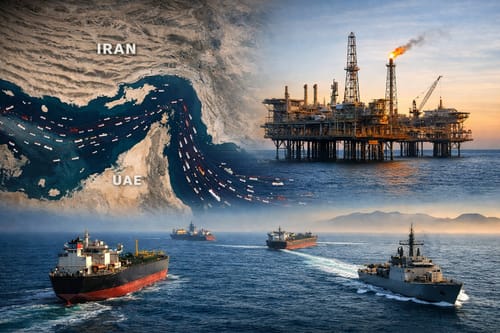
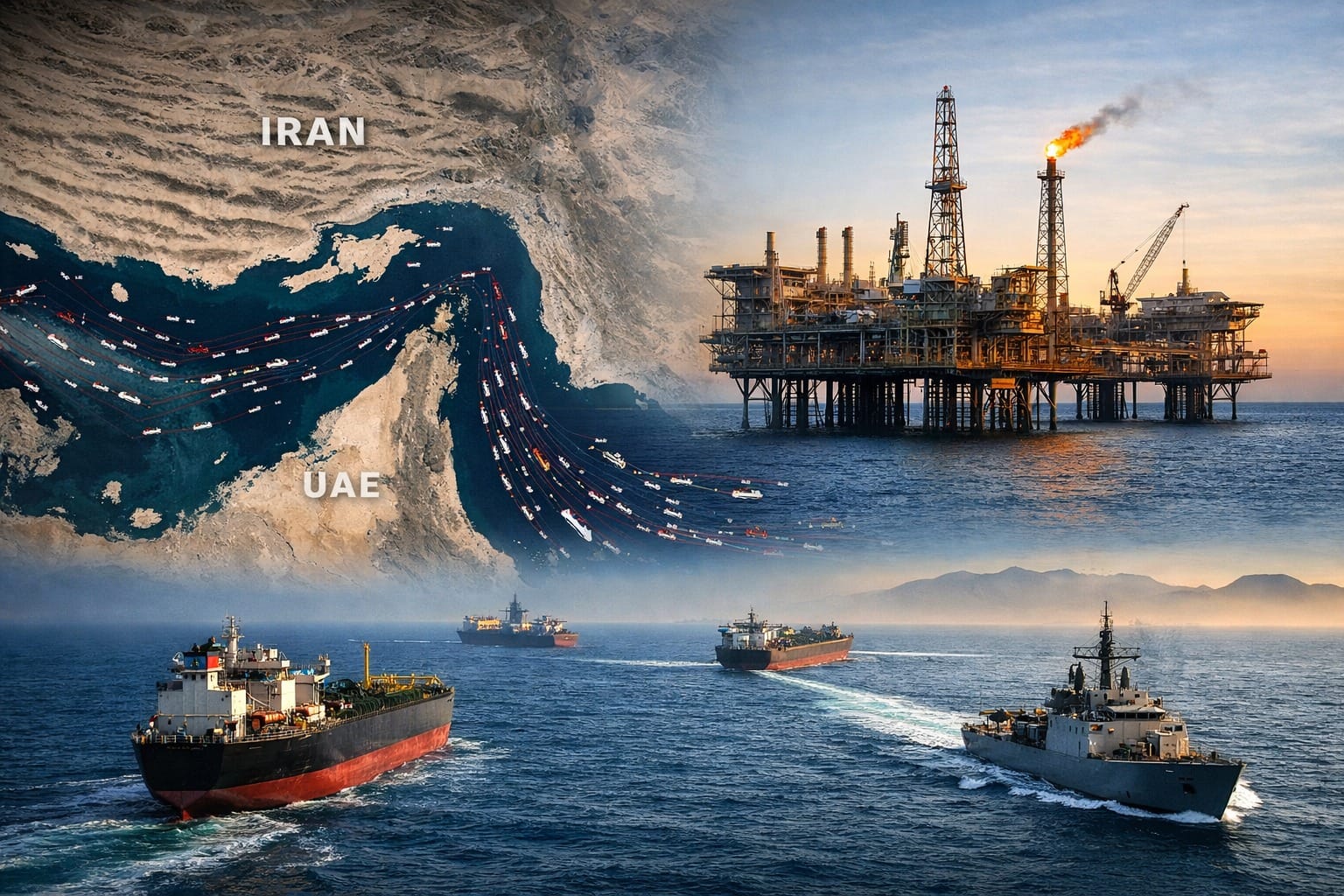
The Strait of Hormuz is 33 kilometres wide at its narrowest point, with navigable shipping lanes of approximately 3 kilometres in each direction. Through this narrow corridor transits approximately 20.9 million barrels per day of crude and petroleum products which is roughly one-fifth of global oil consumption alongside 22% of global LNG trade, significant volumes of jet fuel, LPG, fertilisers, and industrial chemicals. Approximately 84% of Hormuz crude flows are destined for Asian markets: China, India, Japan, and South Korea.17
Iran did not physically mine the strait. By deploying drones selectively in the vicinity of shipping lanes, Iran triggered the withdrawal of marine insurance from commercial vessels transiting the corridor. Hapag-Lloyd, CMA CGM, and other major operators suspended Gulf operations. By March 2, 2026, over 150 tankers (crude carriers and LNG vessels) lay at anchor in open waters, effectively idle.19 OPEC+, meeting in emergency session on March 1, agreed in principle to raise production by 206,000 bpd - a gesture analysts immediately identified as commercially inadequate to replace Hormuz volumes, and geographically constrained by the same closure it was meant to address.20
The question: Why oil is struggling to settled above $100
The market price of Brent crude on March 6-7, 2026 settled in the $93-94 range representing a weekly gain of approximately 30%, and the largest single-week percentage gain for WTI futures since records began in 1983.21 Yet as of this writing, the price has not settled above $100. In the face of what is empirically among the worst supply disruptions in the post-1973 era, this restraint warrants careful structural analysis.
Several factors explain the price ceiling. First, the starting conditions were deeply oversupplied. The EIA's February 2026 Short-Term Energy Outlook had projected Brent averaging $58 per barrel for full-year 2026 - a market running ahead of demand with inventory builds projected through 2027.22 Global oil production growth had been driven largely by South American and non-OPEC producers. The starting point before the conflict (Brent at $67/bbl in January 2026) was structurally low, giving the price more room to move upward before triggering demand destruction.
Second, IEA Strategic Petroleum Reserve (SPR) mechanisms provide near-term buffer capacity. Coordinated IEA drawdowns can sustain approximately 24 million bpd for several months which is sufficient to cover Hormuz disruption volumes in the short term, though not indefinitely under full closure conditions.
Third, and most commercially significant, the futures curve is signalling that the market expects resolution. Brent May 2026 settled at $92.69, while the June contract was at $87.20, July at $82.88, and September at $77.82.23 This steep backwardation tells capital allocators something important: the market is not pricing a structural supply rupture. It is pricing a severe but finite disruption, with the expectation of Hormuz reopening, partial re-routing, and US naval escort arrangements being operationalised. Trump's announcement of US Development Finance Corporation insurance for Gulf tankers dampened a potential 9%+ surge to a 4.7% gain in a single session on March 3 meaning by the market is explicitly pricing US military credibility as a partial substitute for physical corridor access.24
Fourth, oil intensity of the global economy has declined materially. GDP per barrel of oil has improved by approximately 36% over the 25 years to 2024, a combination of efficiency gains and economic diversification.25 The demand destruction mechanism kicks in faster at a lower oil price than in previous supply crises. This structural demand-side flexibility provides a price ceiling that the 1973 and 1979 crises did not have.
The scenario that breaks through $100 and potentially toward the $150 that Qatar's Energy Minister Saad al-Kaabi warned the Financial Times was possible26 requires a different set of conditions: Iraq's approximately 1.5 million bpd of shut-in production failing to recover, Kuwait's emerging constraints deepening, UAE exports unable to re-route through Fujairah at scale, and the Hormuz de facto closure persisting beyond three to four weeks.27 JPMorgan has noted that production cuts could approach 6 million bpd if the Strait remains blocked by end of the following week.28 At that scale, demand destruction alone cannot hold the price below triple digits, and the QatarEnergy North Field East delay with the 33 mtpa four-train expansion already pushed back to end-2026 removes a meaningful near-term LNG price buffer from the market.29
Want deeper insights? Get access to detailed macrointelligence, scientific white papers, and investor briefings by subscribing to premium...
Already have an account? Log In
V. Saudi Arabia, Qatar, and the regional energy framework under stress
For Saudi Arabia, the commercial calculus is complex. Higher oil prices provide short-term fiscal relief. Riyadh's fiscal breakeven for 2026 was estimated at approximately $75-80 per barrel before the crisis, and prices are now comfortably above that level. But sustained Hormuz disruption that prevents Saudi exports from reaching Asian markets at scale is commercially damaging in ways that price increases cannot offset. Riyadh's own sources indicated to Reuters that it had been quietly increasing production in anticipation of US strikes - a signal that the kingdom knew the conflict was coming and was positioning for it. Whether that reflects strategic coordination with Washington or simply pragmatic hedging is a question one should hold.
Qatar's situation is more acutely fragile, and the Ras Laffan strikes are strategically revealing. On March 2, Iranian drones struck both Ras Laffan Industrial City and the Mesaieed Industrial Area, the twin pillars of Qatar's entire LNG export architecture. QatarEnergy declared Force Majeure on its contracts and halted all gas production. With oil and gas constituting approximately 80% of Qatar's government revenues, the strikes delivered precisely targeted economic coercion.30
The Ras Laffan strikes are not geopolitically random. Iran targeted the exact facilities that process and monetise North Dome gas- the gas that Qatar extracts nine times more efficiently than Iran extracts South Pars from the same shared reservoir. The strikes were directed at the single asset that most visibly quantifies Iran's opportunity cost of isolation.
Europe enters the picture with its own acute vulnerability. The continent started 2026 with gas storage at 46 billion cubic metres at end February - compared to 60 bcm in 2025 and 77 bcm in 2024.31 The conflict threatens to disrupt LNG supply at precisely the moment European storage refill season begins, with Qatar which is Europe's second-largest LNG supplier unable to export. Storage refill operations could be disrupted for months, placing severe pressure on industrial energy costs and directly undermining the EU competitiveness agenda that has dominated European policy discourse since the Draghi report.
VI. What Iran wants - and what the theology of rent costs
It would be analytically incomplete to discuss Iran's energy position without addressing the domestic political economy that shapes it. The Islamic Republic has, since 1979, operated a model of hydrocarbon rent extraction that systematically subordinates commercial optimisation to theological, ideological, and geopolitical priorities.
This is a structural observation with direct commercial implications. For IOCs evaluating any post-conflict Iran scenario, the institutional framework matters as much as the reservoir data. NIOC under the Islamic Republic has operated without transparent accounting, without independent reserve certification to global standards, and without the commercial governance frameworks that Western capital markets require. A change of government does not automatically resolve these issues as Iraq demonstrated with painful clarity. Iraq's Technical Services Contracts (TSCs), the upstream model adopted after the 2003 invasion, were so unfavourable to IOCs (fixed fee per barrel, no reserve booking, low IRR) that they triggered an IOC exodus that persists today. BP, Shell, ExxonMobil, and Eni all significantly reduced their Iraq exposure over the subsequent decade, despite Iraq holding the fifth-largest proven reserves in the world.33
Iran's theoretical recovery toward 5-6 million bpd would require sustained annual upstream investment of $10-15 billion, plus $30-35 billion for South Pars compression infrastructure, plus an additional estimated $60-70 billion in downstream and petrochemical investment. Iran's Petroleum Ministry itself cited a need for $185 billion over six years in 2015, under far more favourable conditions than exist today.34 These are not numbers that NIOC can self-finance, that Russia can provide at scale, or that China will risk primary sanctions exposure to deliver. The only source of capital that can move at these numbers is Western IOC and institutional capital which will not move without a commercial and legal framework that simply does not yet exist.
VII. The post-conflict IOC re-entry Scenario: What it actually looks like
For C-suite executives and capital allocators who may be tempted to model a 'post-conflict reopening dividend' from Iranian hydrocarbons, a clear-eyed assessment of what re-entry would actually require is essential.
The Iranian Petroleum Contract (IPC) model introduced in 2016 as Iran's most IOC-friendly upstream framework is the legal baseline from which any re-entry negotiation would begin. Its key features: 20-year terms (extendable for EOR); a Joint Venture structure where NIOC or a subsidiary holds at least 51%; the ability for IOCs to book reserves in some circumstances; a local content requirement of 51% of the value of work; and a mandatory technology transfer obligation. The IPC is structured as a risk service contract rather than a production sharing agreement (PSA) - Iran's constitution prohibits foreign ownership of hydrocarbons, making a true PSA impossible.35
IOC responses to the IPC, even before the current conflict, were sceptical. The principal objections: limited reserve-booking certainty; 51% local content creates operational risk through mandatory partnering with Iranian E&P companies of variable technical and financial capacity; technology transfer obligations reduce the commercial value of proprietary EOR know-how; and most critically the absence of force majeure protection against sanctions snapback, which had twice already (2012 and 2018) forced IOC exits at commercial cost. TotalEnergies and CNPC signed the first post-JCPOA IPC for South Pars Phase 11 in July 2017. By 2019, both had withdrawn following renewed US sanctions.
In a post-conflict scenario, the sequencing of re-entry creates a minimum three-to-five year horizon before meaningful new Iranian production reaches market. The sequence runs: political transition or governance restructuring → new sanctions architecture negotiation → NIOC institutional reform and reserve auditing to global standards → IPC renegotiation to post-conflict terms → field rehabilitation and reservoir assessment → initial development investment → production ramp-up. Each stage is contingent on the preceding one. The EOR and compression work required to restore South Pars alone, which involves fabricating and deploying offshore platforms of 20,000 tonnes has a minimum engineering timeline of three to four years from contract award to installation, under optimal conditions.
The Iraq comparison is instructive but imperfect. Iraq's post-2003 IOC re-entry ultimately generated real production gains from approximately 2 million bpd at the time of the invasion to over 4.5 million bpd by the mid-2020s but at a total intervention cost estimated at over $2 trillion for the US, and over a 20-year horizon.36 Iran is institutionally more cohesive than Saddam's Iraq, has a more diversified and educated technocratic class, and a non-oil private sector that has survived sanctions better than Iraq's did under the Ba'ath regime. This cuts both ways: a post-conflict Iran may be more resilient and capable of managed transition, but also more resistant to externally imposed governance frameworks.
VIII. Implications: Iran, the US, the Middle East, and the world
For Iran
The conflict has accelerated an energy crisis that was already structurally acute. South Pars pressure is declining irreversibly without compression installations only Western engineering can supply - installations now further delayed by the physical destruction of military infrastructure and the disruption to any potential NIOC investment programme. Iran's production recovery from 2020 to 2025 was achieved through reviving idle wells and optimising mature fields, not through new development. The physical destruction of infrastructure now compounds a pre-existing capital deficit that was already unresolvable without Western engagement.
Paradoxically, the conflict may create the conditions under which Western IOC re-entry becomes politically possible for the first time since 1979. But the path is long with demandingpreconditions. A post-conflict Iran faces a hydrocarbon sector that will require at minimum a decade of sustained investment to restore to pre-2020 levels, let alone approach its theoretical ceiling.
Want deeper insights? Get access to detailed macrointelligence, scientific white papers, and investor briefings by subscribing to premium...
Already have an account? Log In
For the United States
The commercial logic of controlling Iranian hydrocarbons is seductive in theory and expensive in practice. The Iraq precedent of over $2 trillion in direct expenditure, a power vacuum that ultimately enhanced Iran's regional influence, and IOC terms so unfavourable that a second exodus followed the first entry is a data point. Iran is a more complex, more internally cohesive, and more institutionally sophisticated state than Saddam's Iraq.
US shale cannot substitute for Hormuz volumes in the near term. Oilprice.com analyst has noted that the Permian Basin, the core of US shale growth is facing marginal productivity decline, and the logistical infrastructure for rapidly expanding US LNG exports to Asia simply does not exist at the required scale.37 The US economy, which had not yet fully absorbed the inflationary effects of Trump-era tariffs and supply chain restructuring before the conflict, now faces a materially worsened stagflationary scenario if the Hormuz closure extends beyond six weeks.38
Perhaps most counterintuitively, the primary near-term strategic beneficiary of the disruption to Iranian oil flows to China is Russia. As Carnegie Endowment notes, with both Iran and Venezuela whose US-aligned new government has curtailed exports to China now compromised as supply sources, Russia steps into the gap China must fill. The US has, in targeting Iran's energy supply relationship with China, inadvertently strengthened Russia's leverage over China's energy security and India, itself a major alternative buyer of discounted Russian crude, now faces sharply higher import costs that complicate its own strategic calculations.39 This is an outcome that deserves more analytical attention than it is currently receiving.
For the Middle East
The regional energy ecosystem that underwrites Gulf state prosperity - stable Hormuz transit, LNG contract certainty, IOC partnerships, sovereign wealth fund accumulation has been stress-tested beyond any previous scenario. Saudi Arabia, the UAE, Kuwait, and Qatar are all exposed. The bypass infrastructure (East-West Pipeline, Fujairah terminal) can absorb a fraction of normal Hormuz volumes. The geopolitical assumption that underwrites Gulf stability, US security guarantees in exchange for moderate oil pricing and petrodollar recycling is being tested in real time. If the Hormuz closure persists beyond four to six weeks, the fiscal deterioration for all Gulf producers except those with significant non-oil revenues will be material and rapid.
CSIS correctly identifies the critical uncertainty for OPEC+ going forward: will the Trump administration demand compensation 'in coin and barrels' for the cost of the military operation? If so, what are the implications for OPEC+ production quotas, Saudi spare capacity utilisation, and the long-term pricing architecture of Gulf oil?40
For the world
The market's current pricing - steep backwardation, Brent below $100, forward curve signalling resolution reflects a bet on de-escalation. That bet may prove correct. But it is a bet, not a forecast grounded in verified logistics. The physical re-opening of Hormuz requires the re-entry of commercial insurers, confirmation of the navigational hazard status of the corridor, and the restoration of super tanker operator confidence. Each step takes time. Each day of closure extends demand destruction effects across Asian industrial economies.
India, importing over 85% of its crude and facing $13-14 billion in incremental annual import costs for every $10 rise in crude prices41 is the most acute near-term casualty. Japan and South Korea, with limited indigenous energy and structural Hormuz dependence, face similar vulnerability. Natural gas markets, already more volatile than oil, have seen prices rise by more than 40% since the conflict began42 with Europe's low storage position creating an additional layer of fragility.
IX. The unspoken dimension: What the crisis means for the energy transition
Almost every piece of current commentary on the Iran conflict frames the stakes in terms of fossil fuel economics: production volumes, price trajectories, sanctions regimes, IOC access. This is understandable but analytically incomplete. The Age of Transformation framework demands that we ask the harder question: what does this crisis mean for the structural shift that was already reshaping the global energy system before the first missile was fired?
The answer is bifurcated, and the bifurcation is commercially significant. For major energy-importing economies - the EU, China, India, Japan, and South Korea, the crisis has made what was previously a long-term climate argument into an immediate national security argument. Energy dependence on Hormuz-transiting hydrocarbons has been exposed as a structural vulnerability that no amount of diplomatic hedging can mitigate. The EU, which learned this lesson partially from Russia's weaponisation of gas supply post-2022, is now experiencing the same dynamic in oil and LNG. The policy response will be an acceleration of domestic renewable deployment, grid investment, and strategic storage driven by defence ministries in addition to Paris Agreement commitments.43
China's response is particularly telling. Chinese EV penetration is already reducing oil demand by over 1 million bpd relative to the baseline trend, a figure projected to increase by a further 600,000 bpd in the following year, as per Rhodium Group.44 China's strategic petroleum reserve build-out (approximately 1 million bpd of additional stockpiling in 2026 before the conflict) reflects a long-term energy security strategy in which domestic clean energy and SPR depth provide a buffer against exactly the geopolitical disruption now materialising. The conflict has accelerated China's energy transition trajectory.
For the United States and other hydrocarbon-rich states, the crisis creates a different dynamic: the short-term case for 'energy dominance' maximising fossil fuel production as a geopolitical instrument is strengthened by the visible fragility of Hormuz-dependent supply chains. US LNG export expansion, shale production maintenance, and Venezuelan crude redirection all become more politically viable in this environment. This is the fossil-focused resistance path, and it has short-term commercial logic.
The deeper question, however, is whether the prize being pursued is worth as much in 2035 as it appears in 2026. IEA scenarios and peak oil demand analysis, even in the most conservative transition pathways, suggest that oil demand growth in Asia, the primary market for Iranian barrels begins to plateau by the late 2020s and declines meaningfully through the 2030s. Iran's theoretical production capacity of 5-6 million bpd, if achievable by 2035, would enter a market structurally different from the one that makes it appear so strategically valuable today. The prize is real. The question is whether it remains as valuable by the time it is accessible.
Executive Summary: Real Prize is living on borrowed time
The commercial logic behind America’s Iran gambit is coherent at the level of strategic ambition and deeply problematic at the level of operational reality. Iran’s hydrocarbon wealth - 208 billion barrels of oil, 34 trillion cubic metres of gas, a shared gas reservoir that is the single largest energy asset on earth represents a prize of genuinely civilizational scale. The gap between that wealth and what has been delivered to global markets over the past four decades is itself a measure of the cost of the current political settlement.
The path from military action to commercial access runs through a gauntlet of institutional reconstruction, reserve certification, IPC renegotiation, NOC governance reform, reservoir remediation, and geopolitical realignment that has no precedent in the modern era of resource conflicts. Iraq’s $2 trillion lesson is the base case warning. Iran’s theoretical recovery toward 5-6 million bpd would require sustained annual upstream investment of $10-15 billion, plus $30-35 billion for South Pars compression infrastructure, plus an additional estimated $60-70 billion in downstream and petrochemical investment. Iran’s Petroleum Ministry itself cited a need for $185 billion over six years in 2015, under far more favourable conditions than exist today. These are not numbers that NIOC can self-finance, that Russia can provide at scale, or that China will risk primary sanctions exposure to deliver.
Want deeper insights? Get access to detailed macrointelligence, scientific white papers, and investor briefings by subscribing to premium...
Already have an account? Log In
The deeper question is whether the prize being pursued is worth as much in 2035 as it appears in 2026. IEA scenarios and peak oil demand analysis, even in the most conservative transition pathways, suggest that oil demand growth in Asia, presumably the primary market for Iranian barrels begins to plateau by the late 2020s and declines meaningfully through the 2030s. Iran’s theoretical production capacity of 5-6 million bpd, if achievable by 2035, would enter a market structurally different from the one that makes it appear so strategically valuable today. Rising recovery costs, declining reservoir pressure, and a minimum decade-long re-entry timeline collectively erode the commercial value of reserves that appear transformational on paper.
The energy transition is not waiting. Chinese EV penetration is already reducing oil demand by over 1 million bpd relative to the baseline trend, a figure projected to increase by a further 600,000 bpd in the following year. For major energy-importing economies like the EU, China, India, Japan, and South Korea, the crisis has converted what was previously a long-term climate argument into an immediate national security argument. The policy response will be an acceleration of domestic renewable deployment, grid investment, and strategic storage driven by defence ministries in addition to Paris Agreement commitments. The EU is commissioning more renewables. China is building more EVs. India is relentlessly working towards energy import independence. The Hormuz chokepoint is simultaneously the most powerful argument for fossil fuel strategic control and the most powerful argument for the energy systems that make Hormuzrelatively irrelevant.
The geopolitics of fossil fuel control are being contested at the exact moment the commercial logic underpinning that control is beginning to weaken. The question is whether Prize remains as valuable by the time it is accessible.
Appendix I - Sources & data references
All citations are numbered sequentially as they appear in the text.
1 EIA Country Analysis Brief: Iran, October 2024.
2 TradeImeX, Iran Oil Export Data 2024–25, October 2025; Shale24, Iranian Oil Industry Analysis, January 2026.
3 Visual Capitalist / EIA, One Buyer Dominates Iran's Oil Exports, March 2026.
4 The Conversation, How one massive gas field shapes the global stakes of conflict in the Middle East, March 2026; IEA estimates.
5 Kpler / Alhurra, Iran Needs China More Than China Needs Iran, January 2026.
6 Alhurra, Qatar energy revenue analysis, March 2026.
7 Iran International, March 2024; pgurus.com, North Dome–South Pars analysis, January 2026; NCRI energy report, October 2023.
8 NCRI / Iran International, South Pars compression programme, early 2026; OilPrice.com, Iran Looks To Ramp Up Production In The World's Largest Gas Reservoir, December 2024.
9 Axios, Iran war: Strait of Hormuz will likely hurt US, global economies, March 5, 2026.
10 TradeImeX, Iran Oil Export Data, October 2025; Kpler maritime intelligence.
11 EIA Background Reference: Iran; ScienceDirect, New Iran Petroleum Contract IPC in comparison with Buy-back and PSA, 2024; Lexology, Iran's Upstream Comeback, 2016; OGN, Upstream investment under new Iranian IPC contract.
12 Kpler / Alhurra, Iran Needs China More Than China Needs Iran, January 2026; Newsweek / Kpler, March 2026.
13 The Diplomat, Why China Isn't Worried About New US Sanctions on Iran, January 2026.
14 Middle East Institute, How Iran, China, and Russia Use the Shadow Fleet, March 2026.
15 Carnegie Endowment, How Trump's Wars Are Boosting Russian Oil Exports, March 5, 2026.
16 RFERL / Kpler, March 6, 2026; CBS News, Beijing braces for economic impact as Iran war threatens Chinese oil, March 4, 2026.
17 EIA, H1 2025 Maritime Chokepoint Analysis; Visual Capitalist / EIA, March 2026; Al Jazeera, March 1, 2026; Kpler, March 1, 2026.
18 RFERL, Oil Edges Higher As Debris From Downed Drones Strikes Saudi Ras Tanura Refinery, March 6, 2026.
19 Kpler maritime intelligence, March 1, 2026; NPR, How traffic dried up in the Strait of Hormuz since the Iran war began, March 4, 2026.
20 CNBC, OPEC+ to raise oil output slightly even as Iran war disrupts shipments, March 1, 2026.
21 Bloomberg, Brent Oil Hits $90 as Middle East War Paralyzes Hormuz Traffic, March 6, 2026; CNBC, Oil surges 35% this week for biggest gain in futures trading history, March 6, 2026; Oilprice.com futures data, March 6–7, 2026.
22 EIA Short-Term Energy Outlook, February 2026.
23 Oilprice.com, Brent crude futures data, March 6–7, 2026.
24 CNBC, Oil prices ease after Trump says U.S. will insure tankers, March 3, 2026.
25 CSIS, What Does the Iran War Mean for Global Energy Markets?, March 6, 2026.
26 CNBC, March 6, 2026 (citing Financial Times interview with Qatar Energy Minister Saad al-Kaabi).
27 Wood Mackenzie, cited in Klean Industries, Iran War, Oil Dependency & Energy Transition, March 2026.
28 JPMorgan Commodities Research, Natasha Kaneva, client note cited in CNBC, March 6, 2026.
29 CSIS, March 6, 2026.
30 Alhurra, Qatar energy analysis, March 2026.
31 Bruegel, How will the Iran conflict hit European energy markets?, March 2, 2026.
32 EIA Country Analysis Brief: Iran, October 2024.
33 MEES, PSAs vs Service Contracts: The Case of Iraq; Geopolitical Monitor, Iran Could Change the Face of OPEC; MEES, 2023.
34 Lexology, The Iranian Petroleum Contract: Foreign Investment Reforms, 2016; EIA Background Reference: Iran.
35 EIA Background Reference: Iran; ScienceDirect, New Iran Petroleum Contract IPC, 2024; OGN, Upstream investment under new Iranian IPC contract; Iran Best Lawyer, Understanding Iran Petroleum Contract, September 2025.
36 Brown University, Costs of War Project.
37 Oilprice.com, Natalia Katona, March 5, 2026.
38 Axios, Iran war: Strait of Hormuz will likely hurt US, global economies, March 5, 2026.
39 Carnegie Endowment, Mikhail Korostikov, How Trump's Wars Are Boosting Russian Oil Exports, March 5, 2026.
40 CSIS, What Does the Iran War Mean for Global Energy Markets?, March 6, 2026.
41 INVC / International News and Views, Brent Crude Oil Price Surges Above $94 — Impact on India, March 7, 2026.
42 New Lines Institute, The Energy Shock: US-Israel War with Iran's Impact on Indian, Chinese and Global Economies, March 2026.
43 ENKI AI, US-Iran War 2026: Shock to the Global Energy Transition, March 4, 2026; TIME, War in Iran Will Force a Rethink on Where Energy Comes From, March 6, 2026.
44 RFERL / Rhodium Group, March 2026; EIA Short-Term Energy Outlook, February 2026.