


The American empire is falling. The Trump-Netanyahu war on Iran - launched weeks after the seizure of Venezuela and a formal doctrine claiming imperial jurisdiction over the entire Western hemisphere - is the loudest signal yet. These are the actions of a system at the apex of its ambition and the edge of its collapse: expanding outward with maximum aggression at the precise moment its material foundations are giving way.
I have spent two decades building a framework for understanding moments like this. Across A User's Guide to the Crisis of Civilization (Pluto, 2011), Failing States, Collapsing Systems (Springer, 2017), and the planetary phase shift paper published in the journal Foresight in late 2024, I describe how civilisations - like all complex adaptive systems - pass through an ecological life-cycle of growth, conservation, release (collapse), and reorganisation. When a system enters its late conservation phase, it becomes rigid, over-extended, and dependent on increasingly costly energy flows to maintain its complexity. Multiple subsystems begin to fail simultaneously. And the system's elites, rather than adapting, double down on the very strategies that are destroying it.
The rapidly expanding Trump-Netanyahu war on Iran and Lebanon is that doubling-down - a stress test of a late-stage imperial system whose organising assumptions no longer fit material reality. Energy, geopolitics, finance, and ideology are failing together rather than sequentially, and every indicator suggests the test will be failed.
Before Rome Fell, It Expanded
We have seen this before.
At its height, the Roman Empire stretched from the grey mists of northern Britain to the deserts of Mesopotamia, from the Atlantic coast of Iberia to the banks of the Euphrates. Its roads, aqueducts, and legions were marvels of organisational power. For centuries, the logic of expansion appeared self-reinforcing: more territory yielded more tribute, more tribute sustained more legions, more legions conquered more territory. The sheer scale of Roman dominance seemed to prove that growth was eternal.
It was the overreach that killed it. Every new province required a garrison. Every garrison required supply lines. Every supply line required a bureaucracy to administer it. As the historian Joseph Tainter demonstrated, Rome's complexity carried a thermodynamic cost: each additional layer of administration delivered diminishing returns while demanding ever more energy to sustain. The agricultural base of North Africa - Rome's breadbasket - was degrading from centuries of overuse. The Antonine Plague hollowed out the labour force. Currency debasement destroyed the savings of the middle class. Civil wars shattered the legitimacy of the state. And at the centre of it all was a gap that no emperor could close: the gap between Rome's image of itself - an eternal civilisation blessed by the gods - and the biophysical reality that its organising system was entering terminal decline.
These are the mismatch conditions at the heart of the planetary phase shift framework: when a system's complexity outruns its energy base, when its organisational model can no longer manage the reality it faces, and when the gap between self-image and material truth becomes unbridgeable. Expansion at this stage does not resolve the crisis. It accelerates it.
Imperial Overreach on Two Continents
The United States is simultaneously waging wars of expansion across two hemispheres. In the Middle East, the administration is prosecuting the decades-old neoconservative "Clean Break" strategy - authored by advisers to Benjamin Netanyahu in 1996 - which called for the wholesale redrawing of the political map across Iran, Lebanon, Syria, Turkey, and beyond. The targets identified then are the targets being struck now. As I reported at Byline Times, this war revives the same Israeli blueprint that drove the post-9/11 invasions. It will foment widespread destabilisation, civil war, and regional conflagration.
And in the Western hemisphere, something equally extraordinary is underway. On 5 March 2026, Defence Secretary Pete Hegseth stood before the Americas Counter Cartel Conference at Southern Command and declared:
President Trump has drawn a new strategic map from Greenland to the Gulf of America to the Panama Canal and its surrounding countries. At the Department of War, we call this strategic map the Greater North America. Every sovereign nation and territory north of the Equator, from Greenland to Ecuador and from Alaska to Guyana, is not part of the 'Global South.' It is our immediate security perimeter in this great neighbourhood.
Trump’s new security perimeter encompasses Canada, Mexico, all of Central America, the Caribbean, Colombia, Ecuador, Guyana, and Venezuela - whose government the US seized in January. It encompasses Greenland, which Trump has moved aggressively to acquire. This is a formal doctrine of hemispheric imperial jurisdiction, spoken aloud by the Secretary of War.
Simultaneous territorial reorganisation across two hemispheres. There is no precedent for this in American history. Even at the height of the Cold War, the ambition was containment. This is a new and unprecedented form of American imperialism - and in the adaptive cycle, it has a very specific diagnostic meaning. It signals the paradoxical transition from the conservation phase deep in the unravelling of release: the moment when a system, sensing its own decline, attempts to resolve its internal contradictions by expanding outward. Rome did precisely this in the third and fourth centuries, extending its military commitments even as its energy base was degrading. The Soviet Union poured resources into Afghanistan even as its economic model was collapsing.
The complexity burden of expansion - more coercive reach, more logistical overhead, more fiscal strain, more dependence on external resource flows, and more ideological distance between the imperial self-image and biophysical limits - falls on a system already struggling to sustain what it has.
The question, then, is what material conditions are driving this frantic outward expansion. One answer, potentially, lies beneath the surface.
Want deeper insights? Get access to detailed macrointelligence, scientific white papers, and investor briefings by subscribing to premium...
The End of the Shale Boom
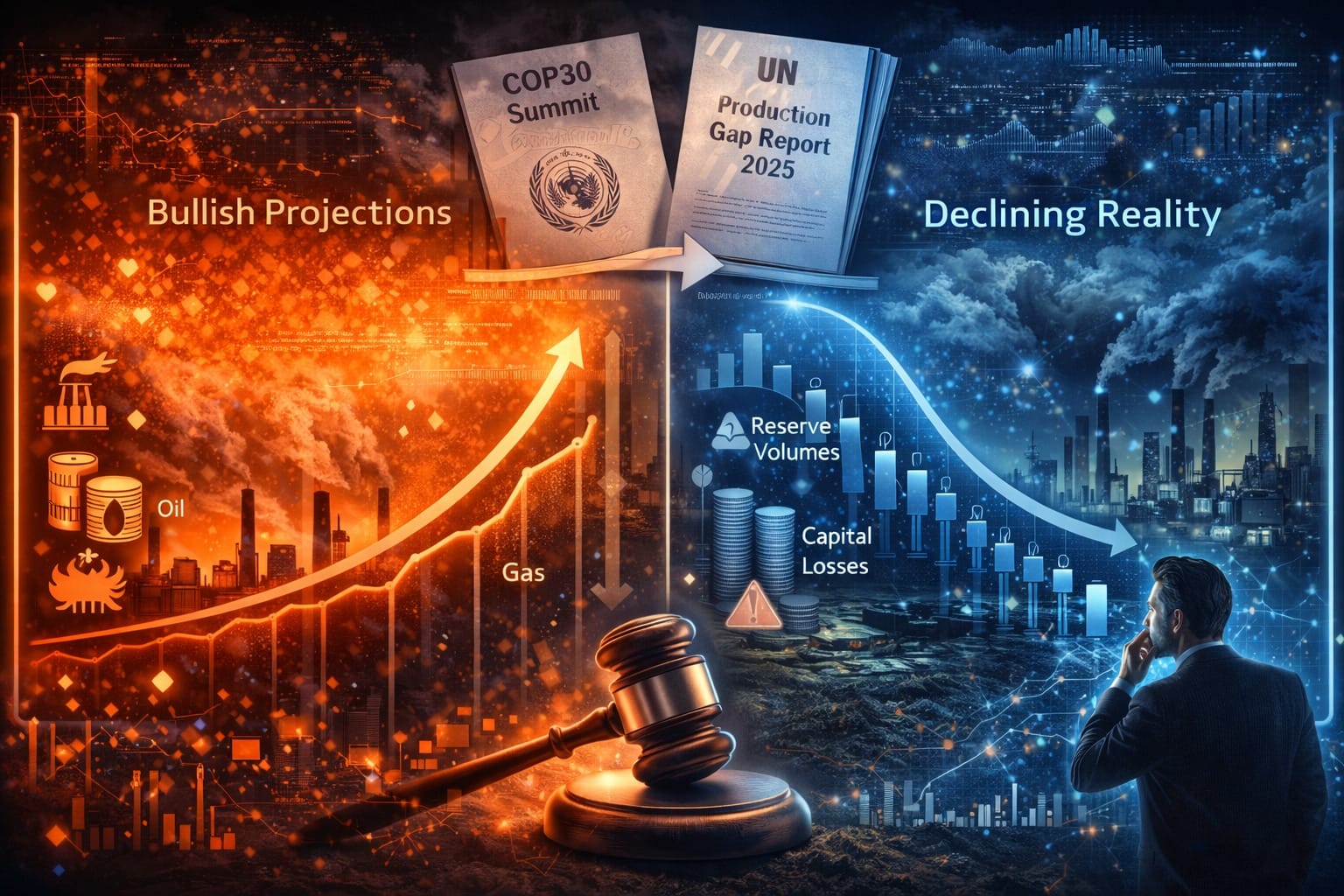
Over the last few years, something happened that most people in the world do not understand and urgently need to: US oil production peaked. The event that the fossil fuel industry spent two decades insisting could never happen, has happened - and faster than official forecasts assumed.
This, arguably, is one of the most consequential events in global history – an inflection point that represents a fundamental biophysical marker of a systemic turning point in the global order which cannot be unwound. And yet, bizarrely, almost no one is talking about it.
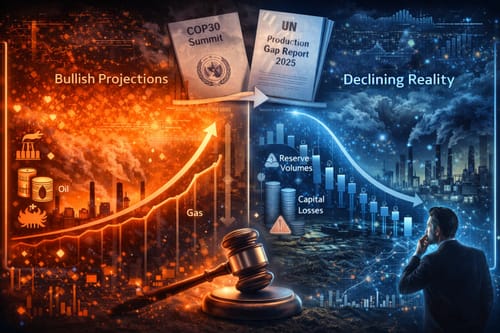
The US Energy Information Administration now projects that US crude oil production will hold near its 2025 record of approximately 13.6 million barrels per day through 2026, before dropping 2% to around 13.3 million barrels per day in 2027 - the first annual decline since 2021. But the EIA's own June 2025 Short-Term Outlook already signalled a sharper trajectory: a peak at 13.5 million barrels per day in the second quarter of 2025, then a slide to around 13.3 million by the end of 2026. Active rig counts have plunged to levels last seen in late 2021. In the Permian Basin - the last major growth engine, accounting for nearly half of all US output - rig totals are falling.
The structural reasons are geological and irreversible. The Bakken and Eagle Ford basins are maturing: declining well productivity, fewer top-tier drilling locations, reduced activity. Even the Permian is approaching the limits of what efficiency gains can extract from a finite resource. And the EIA's longer-term Annual Energy Outlook tells a starker story still: after 2030, US crude oil production begins to decline across most modelled scenarios, as wells become increasingly uneconomic and remaining resources deliver diminishing returns. The agency's own projections show production falling steadily between 2030 and 2050 in multiple cases, as the lack of new drilling takes hold.
It’s happened. The party’s over. The shale boom has entered a plateau and late-maturity phase in which the fantasy of indefinite surge growth is no longer credible. This dovetails with the longer phase shift argument: the fossil system is moving from expansion to diminishing strategic returns - exactly what the adaptive cycle predicts in a system approaching the release phase.
"Drill, baby, drill" is a fantasy. America's own oil industry knows it.
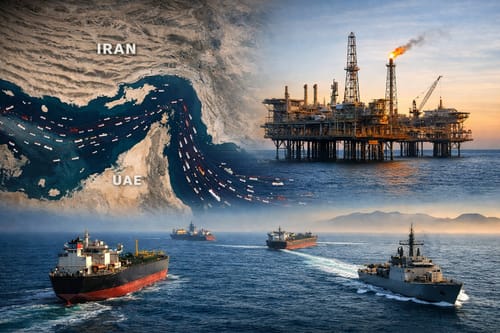
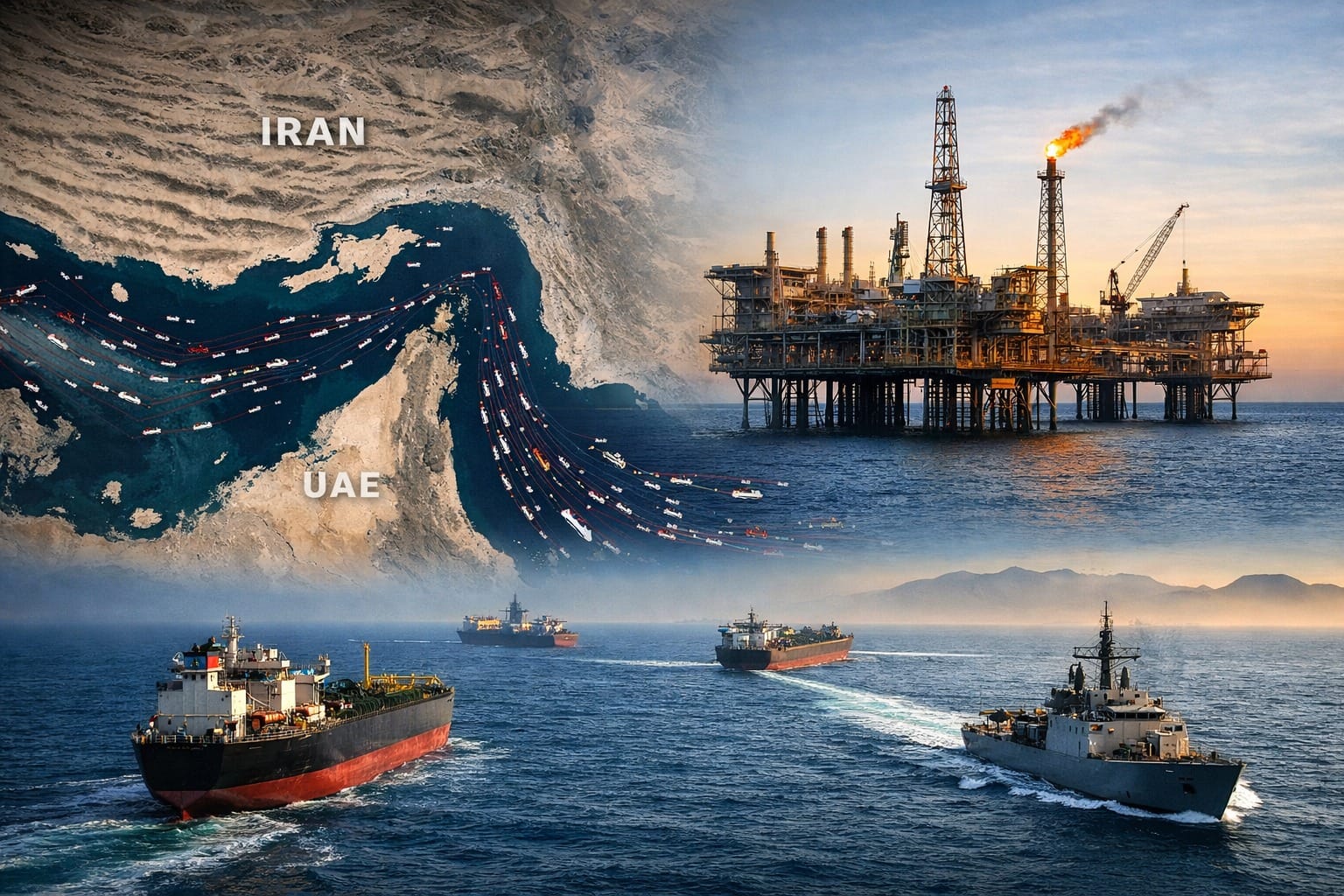
Now consider what the war has done to this picture. The Strait of Hormuz crisis has spiked Brent crude above $80, and if the disruption persists, triple-digit prices are plausible. Higher prices give the US shale industry a temporary jolt of profitability - one that the architects of this war clearly hope will inject new life into a declining system.
But geology is not moved by price signals. Higher oil prices also increase the cost of production itself: steel, services, equipment, and labour all rise in tandem. And for over a decade, publicly traded US shale operators have prioritised shareholder returns over production growth, distributing profits as buybacks and dividends rather than reinvesting in new drilling. The financial discipline that Wall Street imposed after the reckless capital destruction of the 2010s shale boom has become a structural ceiling on output. Even in a high-price environment, the incentive to drill more is constrained by investor demands to return cash - not pour it back into wells with diminishing returns.
The result: the United States cannot meaningfully scale up domestic production or expand exports, even with elevated prices. The system has peaked, and no amount of political rhetoric will reverse it.
That is why the administration has turned outward. Venezuela, which holds the world's largest proven reserves on paper, was seized in January - but in energy return on investment (EROI) terms, those reserves are functionally useless. Venezuela's oil is heavy, sour crude requiring tens of billions of dollars in infrastructure investment, years to bring online, and producing some of the most carbon-intensive barrels on earth. The energy you expend extracting and refining it eats into the energy you get back. Iran, which holds the world's third-largest oil reserves, is the real prize.
Meanwhile, earlier this year the American Petroleum Institute – which presents the crème de la crème of US oil industry - had already pledged that US industry stands ready to be a "stabilising force" in Iran should the regime fall. The war and the oil are inseparable.
Already have an account? Log In
America's Oil Empire Fantasy
With the Strait of Hormuz effectively shut and a fifth of global oil supply removed from the market, the United States finds itself - on paper - in an extraordinary position.
It is now the world's largest oil exporter. It is the world's largest LNG producer. Before halting production, Qatar supplied LNG to buyers across Europe and Asia; QatarEnergy's suspension of LNG operations creates a massive gap that US exporters like ExxonMobil and Cheniere could exploit. Bahrain's oil refinery has been hit. Gulf production and export capacity is severely compromised.
In theory, the disruption hands the US a dominant position as the world's indispensable energy supplier, at precisely the moment when its own reserves have passed the inflection point into slow, terminal decline.
Trump officials appear to believe this. The prevailing assumption, as one administration-aligned analysis put it, is that "the US is mostly insulated from the oil price increase, given that it is now the world's largest crude exporter" - though it acknowledged the country "will import higher prices, given that it imports refined products, and that will be felt at the pump."
This is the imperial fantasy in its purest form. And it is profoundly delusional.
Oil is globally priced. When the Strait of Hormuz closes, the price rises everywhere - including in the United States. LNG is globally repriced at the margin. Shipping insurance and freight costs operate through global chokepoints. Debt-laden economies import inflation even when they export hydrocarbons. The belief that an exporter can profit from a global supply shock while remaining immune to its consequences misunderstands the most basic feature of a tightly coupled system: everything is connected.
And the system is carrying more weight than it has ever carried. The Institute of International Finance reported in February 2026 that total global debt reached a record $348 trillion at the end of 2025, with nearly $29 trillion added in a single year - the fastest annual build-up since the pandemic.
The IMF projects that global public debt reached 93.9% of GDP in 2025 and is on track to breach 100% by 2028. These are levels the IMF describes as "never seen in peacetime." Emerging markets alone face over $9 trillion in debt redemptions in 2026.
Into this system - leveraged to the breaking point - the Trump-Netanyahu war is injecting the most severe energy supply shock since 1973. Sustained triple-digit oil prices will rocket through inflation, dramatically increasing the cost of servicing $348 trillion in debt.
The combustible risk is a global financial crisis is triggered, via cascading defaults and bubble bursts across the AI sector, commercial real estate, manufacturing and heavy industries, cryptocurrency, and the shadow banking system.
These are precisely the sectors with which the Trump empire is most deeply entwined.
The Madness of Twilight
American elites have succumbed to a state of madness. This is a recurring feature of late-stage empires.
Key figures driving the administration's Iran policy are animated by apocalyptic Christian end-times theology - a conviction that military confrontation with Iran is part of a divine plan. This is shaping policy at the highest level.
Even across the pond, we find a kind of jingoistic fantastical madness. On BBC Radio 4's Today programme, Conservative leader Kemi Badenoch leaned on J.R.R. Tolkien and The Lord of the Rings to explain why Britain must join the Trump-Netanyahu war - arguing that to stop the "arrows," you must strike the "archer." Fantasy literature deployed to justify a real war with catastrophic consequences and no idea whatsoever of the strategic risks and complexities involved.
The pattern is ancient. The Roman imperial cult became more elaborate and extravagant as the empire disintegrated.
The Aztec elite responded to cascading ecological crises with escalating human sacrifice.
The Soviet Politburo retreated into ideological fantasy as the economy collapsed.
When a system's organising ideology becomes untethered from the material conditions it is supposed to manage, the system has lost its capacity for self-correction. Every response to crisis amplifies the crisis. In the adaptive cycle, this is the final signature of the unravelling of the conservation phase into the release phase.
A War Designed to Never End
The neoconservative strategy being executed in the Middle East does not envision a quick, decisive outcome. The Clean Break doctrine was always about creating permanent conditions of fragmentation - sustained chaos and destabilisation to neuter Iranian military capabilities and prevent any Middle Eastern power from challenging Israeli or American hegemony. This war is designed to widen and intensify, not to conclude.
That logic, however, guarantees an escalation that neither Israel nor America can control. Iran will continue targeting Gulf oil and gas infrastructure for as long as the bombardment continues. The longer the Strait of Hormuz remains impassable, the longer the Gulf states cannot export, the deeper the fiscal crisis within those states becomes.
Saudi Arabia, the UAE, Qatar, and Bahrain are rentier economies that purchase domestic stability with hydrocarbon revenue. As state revenues decline and budgets strain, domestic unrest will begin to flare. The prospect of simultaneous social upheaval across the Gulf monarchies - during a regional war - is now a live scenario.
The consequences will cascade far beyond the Middle East.
Europe as a proxy target. The US-Israel war functions, whether by design or not, as a proxy assault on European energy security. Europe lost Russian gas after 2022 and partially replaced it with Middle Eastern and American LNG. Now Middle Eastern supply is disrupted, and European dependence on US exports deepens at precisely the moment when the Trump administration is treating European allies with open hostility. Europe faces a compounding energy and financial shock with fewer buffers than at any point since the Second World War.
The blowback loop. The US belief that it can insulate itself from these repercussions is rooted in systems blindness - the inability to see that in a tightly coupled global system, disruptions cascade across every boundary. As the war widens, instability will escalate far outside US control. Prolonged global oil shortages will drive prices higher. Higher prices will feed inflation. Inflation will increase the cost of servicing record debt. Rising debt-service costs will compress budgets, strain corporate balance sheets, and trigger the conditions for cascading financial crisis - bursting multiple bubbles across the very industries that sustain Western economic confidence.
Domestic unrest - everywhere. The upheaval will sweep across the US, the Middle East, and Europe simultaneously as price spikes intensify cost-of-living crises to breaking point for millions. There are already indications the Trump administration is preparing for domestic turbulence: reports have emerged that the Pentagon is planning to deploy more than 23,000 troops across all 50 US states, with senior officials refusing to answer basic questions about the purpose of these plans. Perhaps it is related to anticipating the likelihood that the cost-of-living crisis ignited by a global financial shock will arrive in the American heartland - the very communities whose votes sustain this administration.
Trump and Netanyahu are engineering the conditions for financial and geopolitical blowback that will likely undermine and unravel American power for the foreseeable future. The American economy will not escape the ramifications of a global crisis that reignites a cost-of-living catastrophe to unprecedented levels.
Want deeper insights? Get access to detailed macrointelligence, scientific white papers, and investor briefings by subscribing to premium...
The Paradox: Destruction as Accelerant
The crisis cuts both ways.
On one hand, the war will undermine the clean energy transition in the short term: hiking energy prices, making investment more costly, constraining supply chains. The chaos is spiralling, and its immediate effect is to make everything harder.
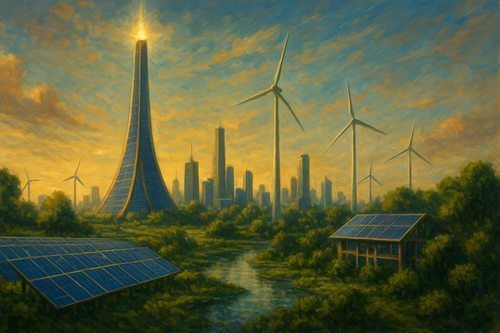
On the other, it will ignite an accelerated desire across the world to wrench away from fossil fuel dependence. Every oil price spike strengthens the economic case for electrification. Every disruption to hydrocarbon supply chains demonstrates that dependence on globally traded fossil fuels is a permanent vulnerability - one that can be weaponised, disrupted, or priced beyond reach at any moment.
As Bill Spindle, former Wall Street Journal bureau chief for South Asia and the Middle East, has written, the result has been a spike in global oil and gas prices, one that is accelerating as it becomes clear the dust in the Gulf will not be settling soon.
Solar arrays paired with batteries are already among the least expensive options for generating electricity, especially compared to LNG.
China has already reduced its LNG imports over the past year and cut out US suppliers entirely.
India, once seen as a prime future customer for LNG, installed record solar capacity last year - almost entirely alongside batteries - and is unlikely to bet its electricity future on gas after this.
Ethiopia banned the import of non-electric vehicles two years ago and is not going back.
As Spindle observes, “events in the Persian Gulf may prove to be a decisive nudge” in the inexorable turning of the global energy system.
He likely underestimates the speed of the transition. It took merely 4-5 years for a country as poor as Pakistan to organically retrofit up to 33 GW of solar. This is larger than the total installed capacity of the United Kingdom. It’s enough to power three New York Cities at their absolute peak.
The devastation and chaos we are about to experience will be the final undoing of the fossil fuel empire.
The economics of solar, wind, and batteries have already crossed the disruption threshold. Optimally designed clean energy systems can produce multiple times more electricity than current demand in virtually every region of the world, at costs an order of magnitude below the legacy fossil fuel system.
Regardless of what America wants, emerging markets and the Global South will seek to end their dependence on fossil fuel imports by accelerating electrification. Because the cost of dependence has become existential.
What we are witnessing is a collision between a declining fossil-fuelled imperial organising system and the emerging conditions of a post-carbon world that can no longer be governed through the same doctrines, infrastructures, or myths.
Already have an account? Log In
What the Phase Shift Demands
The planetary phase shift framework clarifies that what we face is an organising-system crisis. The energy price shock is a symptom; the disease is the system itself. The question is whether states respond to disruption by doubling down on extraction, militarisation, and emergency centralisation - or whether they use the shock to accelerate the next life-cycle through new production systems and new forms of governance.
Here is what that looks like in practice.
1. Wartime electrification as security doctrine
Every country that wants to free itself from these spiralling consequences must treat clean energy deployment as a wartime mobilisation. For the UK and Europe, this means accelerating solar, wind, batteries, grid infrastructure, heat pumps, demand flexibility, EVs, public transport electrification, and industrial electrification at the maximum speed that permitting and supply chains allow. Not "net zero" as a branding exercise, but a core security doctrine. Germany's "freedom energy" framing is instructive: it positions clean energy as independence, abundance, and decarbonisation simultaneously. It argues for abandoning the "all of the above" mindset and focusing on the handful of technologies capable of transforming the whole system.
2. Fossil-risk triage
Europe needs immediate action: mandatory gas storage targets, coordinated procurement, accelerated grid interconnection, emergency conservation plans for industry, and a massive public programme of home insulation and heat-pump deployment - particularly in the UK, where household exposure to gas price volatility remains politically combustible. Europe's existing gas position is fragile enough that even indirect LNG dislocation matters. The objective is to permanently reduce the share of household welfare and industrial competitiveness exposed to the price of imported molecules.
3. Electricity market redesign
A system increasingly powered by cheap renewables cannot continue to be governed by a pricing model designed for fossil fuel scarcity. Decouple retail electricity prices from gas wherever possible. Deploy long-term contracts, regulated asset approaches, and public investment vehicles to socialise the benefits of cheap clean power rather than allowing fossil fuel volatility to cascade through household bills and industrial costs.
4. Financial firebreaks
If the war transmits - as the numbers suggest it will - through debt and inflation into a broader financial crisis, Europe and the UK need pre-emptive stability tools: targeted energy support rather than blanket subsidies, liquidity backstops for utilities and commodity traders, stress tests for insurers and pension funds under sustained energy price spikes, and sovereign investment vehicles to accelerate productive transition assets rather than merely compensating losses.
5. Food and fertiliser resilience as core security
The Hormuz disruption is simultaneously an LNG, ammonia, fertiliser, shipping, and desalination crisis. Respond with accelerated electrified fertiliser pathways, regional nutrient recycling, strategic reserves where appropriate, and investment in distributed agroecological production that reduces dependence on globally traded inputs.
6. Democratic resilience
Energy price shocks are the conditions under which authoritarian, xenophobic, and securitised politics flourish. As I documented in Failing States, Collapsing Systems, systemic crisis generates militarisation and political reaction unless the social response is consciously reorganised around justice, participation, and material security. For the UK and Europe, that means protecting civil liberties, providing emergency support for vulnerable households, resisting the politics of scapegoating, and building community-scale ownership into the new energy economy. Because retreating into fascism during crisis is a recipe of a cycle of disaster and collapse.
7. A global coalition beyond the West
Emerging markets and the Global South will not wait for Western strategic coherence. Repeated fossil fuel shocks will drive import-dependent nations toward accelerated electrification, distributed renewables, batteries, and local production - because dependence itself has become intolerable. Europe should support this through finance, technology transfer, and debt restructuring rather than treating decarbonisation as a fortress project. Forge new coalitions of resilience with partners across Africa, parts of the Middle East, Central Asia, South Asia, and Southeast Asia, as well as with Canada and Australia.
Stop Trying to Restore the Old Equilibrium
The central policy error of late-stage empires - the error that Rome made, the error the Soviets made, the error the Trump administration is making now - is to treat each systemic rupture as a temporary emergency through which the old order can be restored.
The planetary phase shift framework says the opposite. The old order cannot be restored. The fossil fuel system is entering structural decline. The financial architecture built on the assumption of endless extraction is buckling under its own weight. The military expansion that is supposed to secure resources and project dominance is generating the very instabilities that will consume the system from within.
The task is to use the rupture to reorganise around the next system: distributed clean energy at superabundant scale, wider ownership of productive assets, community governance, circular material flows, and a public philosophy grounded in science-based planetary stewardship that recognises the centrality of human unity, compassion and love to our very survival on Planet Earth.
The alternative - an extractive supremacy death cult that doubles down on fossil fuels, military overreach, and financial fantasy - is on track to cannibalise itself.
We are the first civilisation to possess the flight recorder - the accumulated records of those who crashed before us. The Romans, the Maya, the medieval Europeans all lived through their respective release phases blind to the mechanics of the cycle. We have the data. We have the framework. We have the technologies for the next system already scaling.
The system is about to enter its most turbulent period of catastrophic decline. This is terrifying. The ramifications will be disastrous. But regardless of the fanatical fantasies of those at its helm, there is no going back.
And this is all the more reason that those of us who can see, to use what we can see to co-create differently in the world, together. We need to scale a different way of seeing and being in the world. So that more of us can act on what we know, while there is still time to shape what comes next.
If you appreciated this piece, sign up to get this newsletter delivered straight to your inbox for free. Or join premium to get access to deeper insights, white papers, scientific research and macrointelligence reports
Already have an account? Log In